Question
How does colour appear in coordination compounds? Its explanation is based on crystal field theory.
Answer

self

Need a full question paper?

Generate a complete, print-ready paper with questions like this in minutes — across 16+ boards, with answer keys.

Start Generating Free

Similar questions

Describe the common name system and IUPAC system of naming amines.
Write the chemical reactions of $C _2 H _5 OH$ with following compounds :
(i) $CH _2 N_2$ (diazomethane) (ii) ketone, (iii) $HC \equiv$ $C H$ (iv) $C H _3 N C O$ (Methyl-isocyanate) (v) $C H _3 C H O$ (ethanol) (vi) conc. $H _2 SO _4$ at $0^{\circ} C$.
Explain the energy distribution curve of gaseous molecules and also discuss the effect of temperature on it.
  1. Account for the following:
    1. Mn shows the highest oxidation state of +7 with oxygen but with fluorine it shows the highest oxidation state of +4.
    2. Cr2+ is a strong reducing agent.
    3. Cu2+ salts are coloured while Zn2+ salts are white.
  2. Complete the following equations:
    1. $2\text{MnO}_{2} + 4\text{KOH} + \text{O}_{2} \xrightarrow{\Delta}$
    2. $\text{Cr}_{2}\text{O}^{2-}_{7}+ 14\text{H}^{+} + 6\text{I}^{-}\xrightarrow{}$
(i) Define the order of a reaction.
(ii) Explain the effect of concentration of reactant on the rate constant.
(iii) For a first order reaction, if the rate constant at 500 K and 600 K are $0.03 s^{-1}$ and $0.06 s^{-1}$ respectively, then calculate the activation energy.
$
\left[R=8.314 JK^{-1} mol^{-1}, \log 2=0.3010\right]
$
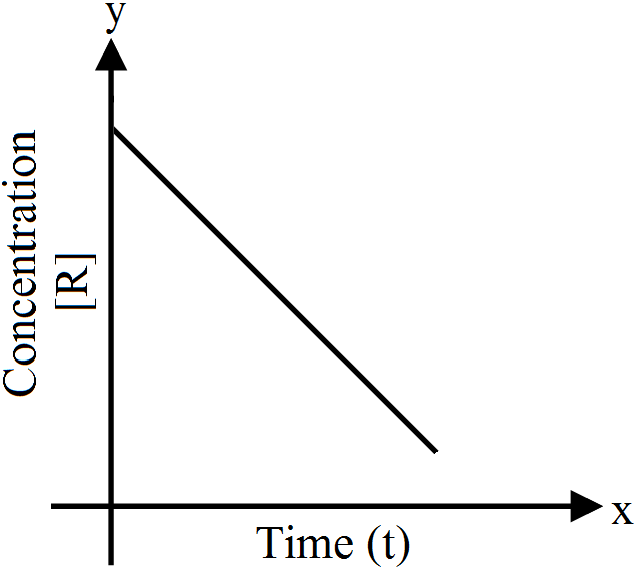
Consider the reaction $\text{R}\xrightarrow{\ \ \text{k}\ \ } \text{P}.$ The change in concentration of R with time is shown in the following plot:

  1. Predict the order of the reaction.
  2. Derive the expression for the time required for the completion of the reaction.
  3. What does the slope of the above line indicate?

Explain oxidation and reduction reactions of carbonyl compounds.
  1. Complete the following chemical equations:
  1. $\text{Cr}_{2}\text{O}_{7}^{2-}\text{(aq)}+\text{H}_{2}\text{S}\text{(g)}+\text{H}^{+}\text{(aq)}\rightarrow$
  2. $\text{Cu}^{2+}\text{(aq)}+\text{I}^{-}\text{(aq)}\rightarrow$
  1. How would you account for the following:
  1. The oxidising power of oxoanions are in the order VO+2 < Cr2O2–7 <MnO4.
  2. The third ionisation enthalpy of manganese (Z = 25) is exceptionally high.
  3. Cr2+ is a stronger reducing agent than Fe2+.
[A], [B], [C], [D], [E], [F] and [G] are amines each of which forms a hydrochloride containing 32.42% chlorine. [A], [B], [C] and [D] evolve N2 on reaction with HNO2, but [E], [F], [G] and [H] do not. Give structures of [A] to [H] with reasons.
Write the $S _{ N } 1$ mechanism of unimolecular nucleophilic substitution reaction.