Excretion and Osmoregulation — Biology STD 11 Science — Question
Maharashtra BoardEnglish MediumSTD 11 ScienceBiologyExcretion and Osmoregulation5 Marks
Question
How does counter current mechanism help concentration of urine?
✓
Answer
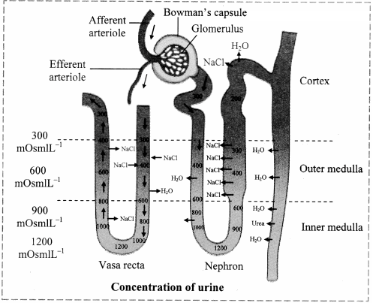
Under the conditions like low water intake or high water loss due to sweating, humans can produce concentrated urine. This urine can be concentrated around four times i.e. $1200$ mOsm/L than the blood $(300$ mOsm/L$).$ Hence, a mechanism called countercurrent mechanism is operated in the human kidneys. The countercurrent mechanism operating in the Limbs of Henle’s loop of juxtamedullary nephrons and vasa recta is as follows:
It involves the passage of fluid from descending to ascending limb of Henle’s loop.
This mechanism is called countercurrent mechanism, since the flow of tubular fluid is in opposite direction through both limbs.
In case of the vasa recta, blood flows from ascending to descending parts of itself.
Wall of descending limb is thin and permeable to water, hence, water diffuses from tubular fluid into tissue fluid due to which, tubular fluid becomes concentrated.
The ascending limb is thick and impermeable to water. Its cells can reabsorb $Na^+$ and $Cl^–$ from tubular fluid and release into tissue fluid.
Due to this, tissue fluid around descending limb becomes concentrated. This makes more water to move out from descending limb into tissue fluid by osmosis.
Thus, as tubular fluid passes down through descending limb, its osmolarity (concentration) increases gradually due to water loss and on the other hand, progressively decreases due to $Na^+$ and $Cl^–$ secretion as it flows up through ascending limb.
Whenever retention of water is necessary, the pituitary secretes ADH. ADH makes the cells in the wall of collecting ducts permeable to water.
Due to this, water moves from tubular fluid into tissue fluid, making the urine concentrated.
Cells in the wall of deep medullar part of collecting ducts are permeable to urea. As concentrated urine flows through it, urea diffuses from urine into tissue fluid and from tissue fluid into the tubular fluid flowing through thin ascending limb of Henle’s loop.
This urea cannot pass out from tubular fluid while flowing through thick segment of ascending limb, DCT and cortical portion of collecting duct due to impermeability for it in these regions.
However, while flowing through collecting duct, water reabsorption is operated under the influence of ADII. Due to this, urea concentration increases in the tubular fluid and same urea again diffuses into tissue fluid in deep medullar region.
Thus, same urea is transferred between segments of renal tubule and tissue fluid of inner medulla. This is called urea recycling; operated for more and more water reabsorption from tubular fluid and thereby excreting small volumes of concentrated urine.
Osmotic gradient is essential in the renal medulla for water reabsorption by counter current multiplier system.
This osmotic gradient is maintained by vasa recta by operating counter current exchange system.
Vasa recta also have descending and ascending limbs. Blood that enters the descending limb of the vasa recta has normal osmolarity of about 300 mOsm/L.
As it flows down in the region of renal medulla where tissue fluid becomes increasingly concentrated, $Na^+, Cl^–$ and urea molecules diffuse from tissue fluid into blood and water diffuse from blood into tissue fluid.
Due to this, blood becomes more concentrated which now flows through ascending part of vasa recta. This part runs through such region of medulla where tissue fluid is less concentrated.
Due to this, $Na^+, Cl^–$ and urea molecules diffuse from blood to tissue fluid and water from tissue fluid to blood. This mechanism helps to maintain the osmotic gradient.
Need a full question paper?
Generate a complete, print-ready paper with questions like this in minutes — across 16+ boards, with answer keys.