Question
How does electronegativity and non - metallic character related to each other?

Answer

Electronegativity is directly related to the non - metallic character of elements.
Therefore, the rise in electronegativities across the period is followed by an increase in non - metallic properties of elements. Consequently, the decrease in electronegativities down the group is accompanied by an decrease in non - metallic properties of elements.

Need a full question paper?

Generate a complete, print-ready paper with questions like this in minutes — across 16+ boards, with answer keys.

Start Generating Free

Similar questions

Can the following reaction,
$\text{Cr}_{2}\text{O}^{2-}_7 + \text{H}_{2}\text{O}\rightleftharpoons 2\text{CrO}^{2-}_{4} + 2\text{H}^{+}$
be regarded as a redox reaction?
In 20 ml 0.2 N KOH , how much ml of 0.1 $N H _2 SO _4$ is added so that solution becomes neutral?
The first $(\Delta_{1}\text{H}_{1})$ and the second $(\Delta_{1}\text{H}_{1})$ ionization enthalpies (in $\mathrm{kJ} \mathrm{~mol}^{-1}$ ) and the $(\Delta_{1}\text{H}_{1})$ electron gain enthalpy (in $\mathrm{kJ} \mathrm{~mol}^{-1}$ ) of a few elements are given below:
Elements $\Delta\text{H}_{1}$ $\Delta{\text{H}}_{2}$ $\Delta_{\text{eg}}\text{H}$
I 520 7300 -60
II 419 3051 -48
III 1681 3374 -328
IV 1008 1846 -295
V 2372 5251 +48
VI 738 1451 -40
Which of the above elements is likely to be:
The most reactive metal.
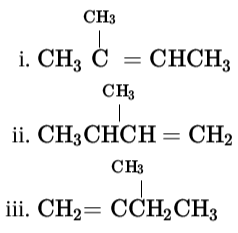
Arrange the following alkenes in the decreasing order of stability.
Image
If the $K _{\text {sp }}$ of AgCl is $4 \times 10^{-8}$ then in 15 lit of its saturated solution, how much AgCl is added?
Carbon monoxide is readily absorbed by ammoniacal cuprous chloride solution but carbon dioxide is not. Explain.
Which of the following orbitals are degenerate?
$3 \mathrm{~d}_{\mathrm{xy}}, 4 \mathrm{~d}_{\mathrm{xy}}, 3 \mathrm{~d}_{\mathrm{z}^2}, 3 \mathrm{~d}_{\mathrm{yz}}, 4 \mathrm{~d}_{\mathrm{yz}}, 4 \mathrm{~d}_{\mathrm{z}^2}$
The first $\left(\mathrm{IE}_1\right)$ and second $\left(\mathrm{IE}_2\right)$ ionisation energies $(\mathrm{kJ} / \mathrm{mol})$ of a new element designated by Roman numerals are shown below:
 
$\text{IE}_1$ $\text{IE}_2$
I
2372
5251
II
520
7300
III
900
1760
IV
1680
3380
Which of these elements is likely to be (a) a reactive metal, (b) a reactive non metal, (c) a noble gas, and (d) a metal that forms a binary halide of the formula, $\mathrm{AX}_2$?

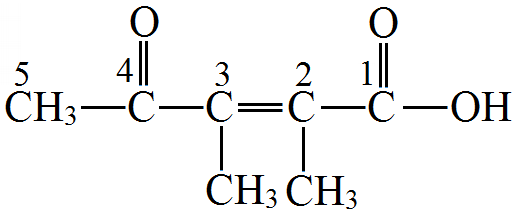
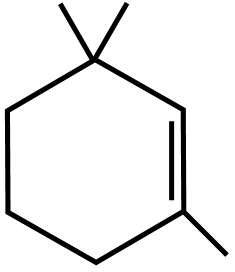
Write IUPAC names of the following:
  1.  
  1. .
Distinguish clearly between salt-like and covalent hydrides.