Question
How does the doctor’s syringe work?
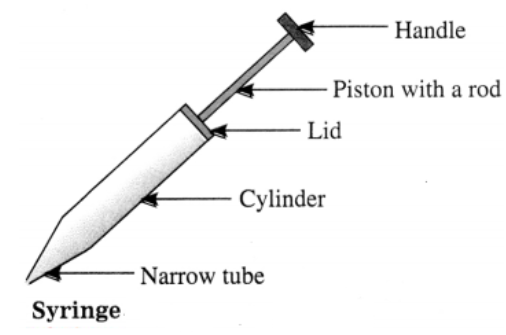
tube. The snugly fitting piston can slide in , and out smoothly. The rod connected to the i piston passes through a hole in the centre of the lid and has a handle at the other end.
When the tip of the narrow tube is dipped in coloured water (or any other liquid) and the piston is pushed towards the tip, up to the bottom, most of the air in the cylinder escapes through the tube, reducing the pressure. When the piston is moved up, the coloured water rises in the part of the cylinder below the piston due to the atmospheric pressure.
Finally, the inner pressure equals the atmospheric pressure and no more coloured water enters in or comes out. To spray the coloured water, the tube is taken out and the piston is moved towards the opening of the tube. As the inner pressure is now greater than the atmospheric pressure, the coloured water gushes out of the narrow opening of the tube.
The tip of a syringe is fitted with a very fine and hollow needle. The required quantity of medicine can be taken in the syringe with the help of the piston. The medicine can then be injected into the body of a patient using the needle and the piston.
Generate a complete, print-ready paper with questions like this in minutes — across 16+ boards, with answer keys.
| Note | Frequency (Hz) |
| sa | 256 |
| Re | 280 |
| Ga | 312 |
| Ma | 346 |
| Pa | 384 |
| Dha | 426 |
| ni | 480 |