MCQ
How does the potential difference change with the effect of the dielectric when the battery remains connected across the capacitor?
  • A
    Increases
  • B
    Decreases
  • Remains constant
  • D
    Becomes zero

Answer

Correct option: C.
Remains constant

As the battery remains connected across the capacitor, so the potential difference remains constant at $V_o$ even after the introduction of the dielectric slab. In this way, dielectric has an effect on potential difference.

Need a full question paper?

Generate a complete, print-ready paper with questions like this in minutes — across 16+ boards, with answer keys.
Start Generating Free

Similar questions

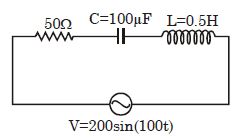
In the given $LCR$  $AC$ circuit, the effective current flowing through the circuit will be.....$A$
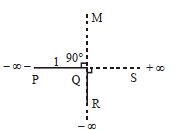
An infinitely long conductor $PQR$ is bent to from a right angle as shown. A current $I$ flows through $PQR$ . The magnetic field due to this current at the point $M$ is $H_1$ . Now, another infinitely long straight conductor $QS$ is connected at $Q$ so that the current in $PQ$ remaining unchanged. The magnetic field at $M$ is now $H_2$ . The ratio $H_1/H_2$ is given by
A light wave travelling linearly in a medium of dielectric constant $4,$ incident on the horizontal interface separating medium with air. The angle of incidence for which the total intensity of incident wave will be reflected back into the same medium will be (Given : relative permeability of medium $\mu_{ s }=1)$ 
In Young’s double slit experiment, the distance between the two slits is made half, then the fringe width will become
The magnetic field to a small magnetic dipole of magnetic moment $M$, at distance $ r$  from the centre on the equatorial line is given by (in $M.K.S. $ system)
The magnetic flux linked with a circuit of resistance 100 ohm increases from 10 to 60 webers. The amount of induced charge that flows in the circuit is (in coulomb)
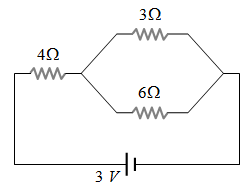
The potential drop across the 3W resistor is
Light of wavelength $\lambda$ in air enters a medium of refractive index $\mu$ . Two points in this medium, lying along the path of this light, are at a distance $x$ apart. The phase difference between these points is :
In a cuboid of dimension $2 L \times 2 L \times L$, a charge $q$ is placed at the centre of the surface ' $S$ ' having area of $4 L ^2$. The flux through the opposite surface to ' $S$ ' is given by
If refractive index of red, violet and yellow lights are $1.42, 1.62$ and $1.50$ respectively for a medium. Its dispersive power will be