Question
How does the resistance of a metallic wire depend on its temperature? Explain with reason.

Answer

With the increase in temperature of conductor, both the random motion of electrons and the amplitude of vibration of fixed positive ions increase. As a result, the number of collisions increases. Hence, the resistance of a conductor increases with the increase in its temperature. The resistance of filament of a bulb is more when it is glowing (i.e., when it is at a high temperature) as compared to when it is not glowing (i.e., when it is cold).

Need a full question paper?

Generate a complete, print-ready paper with questions like this in minutes — across 16+ boards, with answer keys.
Start Generating Free

Similar questions

What are the uses of radioactive isotopes in following?
(a) Medical field,
(b) Agriculture,
(c) Industries?
Define the e.m.f. (E) of a cell and the potential difference (V) of a resistor R in terms of the work done in moving a unit charge. State the relation between these two works and the work done in moving a unit charge through a cell connected across the resistor. Take the internal resistance of the cell as ‘r’. Hence obtain an expression for the current i in the circuit.
State two advantages and two disadvantages of using hydro-energy for producing electricity.
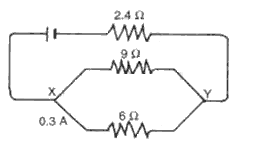
A current of 0.3 A is flowing through a branch of 6 Ω resistors in a junction as shown in fig. . Calculate the
(a) P.d. across the junction XY,
(b) Current flowing through 9Ω and 24Ω
( c) P.d. across 24 Ω resistor, and
( d) e.m.f. of the cell.

Image

(i) Define machine and write functions of a machine.
(ii) Describe mechanical advantage and its types.
(iii) (a) Derive relation between the efficiency, mechanical advantage, and the velocity ratio of a practical machine.
(b) Derive relation between ideal mechanical advantage and velocity ratio for a perfect machine
The V-I graph for a series combination and for a parallel combination of two resistors is shown in Fig – 8.38. Which of the two, A or B, represents the parallel combination? Give a reason for your answer.
A battery of $4$ cell, each of e.m.f. $1.5$ volt and internal resistance $0.5 Ω$ is connected to three resistances as shown in the figure. Calculate:
(i) The total resistance of the circuit.
(ii) The current through the cell.
(iii) The current through each resistance.
(iv) The p.d. across each resistance.
What do you mean by power rating of an electrical appliance? How do you use it to calculate

(a) the resistance of the appliance and

(b) the safe limit of the current in it, while in use?
State and define Ohm’s law.