Question
How does tubular secretion help in maintaining ionic and acid-base balance in body fluids?

Answer

During urine formation, the tubular cells secrete substances like $\mathrm{H}^{+}, \mathrm{K}^{+}$and ammonia into the filtrate. Tubular secretion is also an important step in urine formation as it helps in the maintenance of ionic and acid base balance of body fluids.
  • PCT helps to maintain the pH and ionic balance of the body fluids by selective secretion of hydrogen ions, ammonia and potassium ions into the filtrate.
  • DCT is also capable of selective secretion of hydrogen and potassium ions and $\mathrm{NH}_3$ to maintain the pH and sodium-potassium balance in blood.
  • Collecting duct also plays a role in the maintenance of pH and ionic balance of blood by the selective secretion of $\mathrm{H}^{+}$and $\mathrm{K}^{+}$.

Need a full question paper?

Generate a complete, print-ready paper with questions like this in minutes — across 16+ boards, with answer keys.
Start Generating Free

Similar questions

Which factors were responsible for the extinction of dinosaurs(ancient reptiles)? Why reptiles became the first successful land animals?
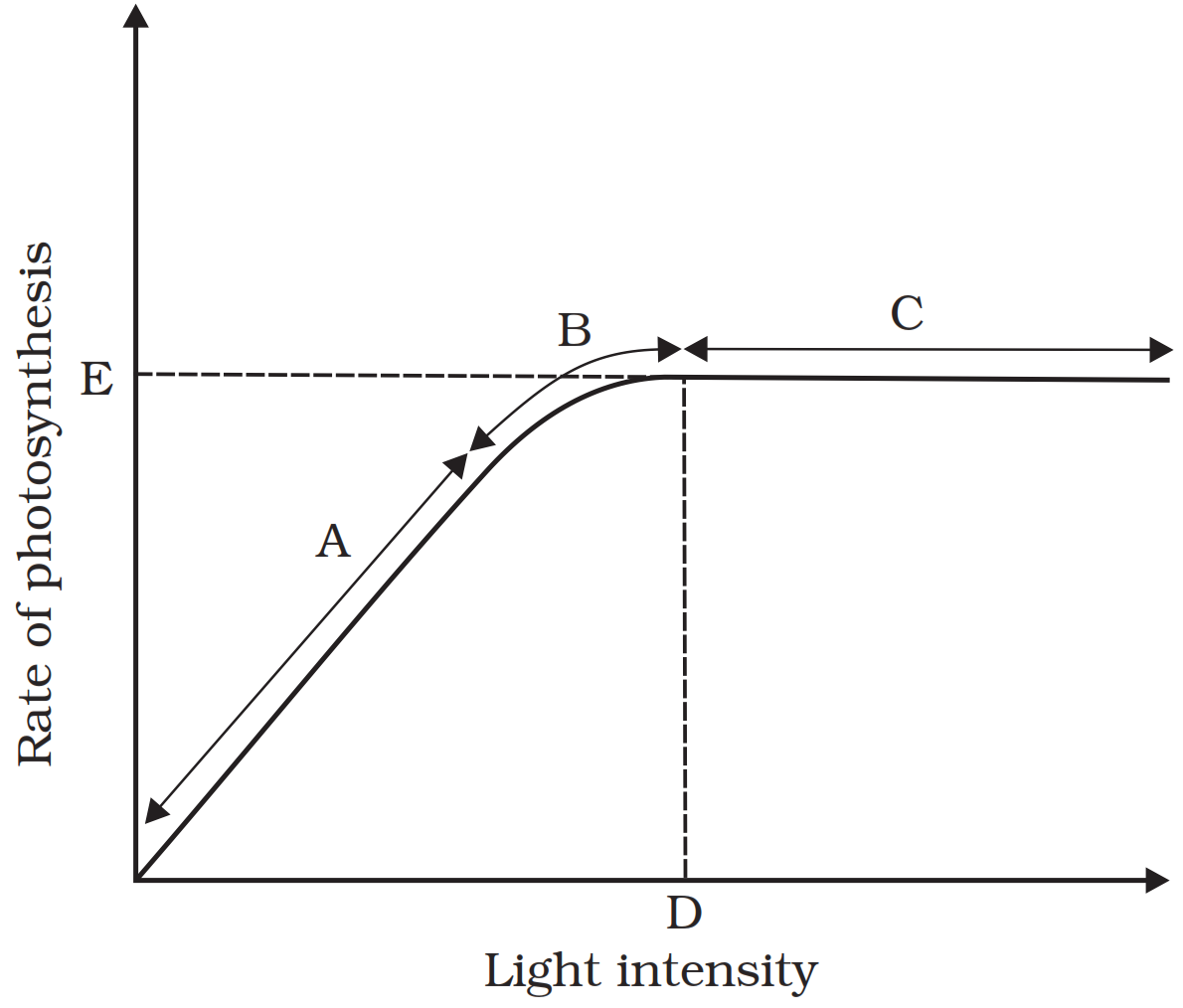
Figure shows the effect of light on the rate of photosynthesis. Based on the graph, answer the following questions:
  1. At which point/s (A, B or C) in the curve is light a limiting factor?
  2. What could be the limiting factor/s in region A?
  3. What do C and D represent on the curve?
A person had roti and dal for his lunch. Trace the changes in those during its passage through the alimentary canal.
Mammals are most adapted among the vertebrates. Elaborate.
What is the significance of meiosis?
Enumerate the assumptions that we undertake in making the respiratory balance sheet. Are these assumptions valid for a living system? Compare fermentation and aerobic respiration in this context.
Which hormones are secreted from the posterior pituitary gland? Explain each one's function in detail.
How do you distinguish between a skeletal muscle and a cardiac muscle?
During explanation of rate of photosynthesis in different colours of light, a biology teacher makes a statement 'Don't put the plant in green light for long time.' After completing the lecture, Kiran asked that 'Is this the reason why plants look green mostly?' The teacher smiled and explained her about it.
  1. What happens, when plant exposed to green light for long time?
  2. What is emission spectrum?
  3. Why plants known as producers?
  4. What values are shown by Kiran as science student?
What is a semi-technical description of a flowering plant?