Question
  1. How is amensalism different from parasitism and competition? Give an example for each.
  2. Define predation.

Answer

  1.  
 
Amensalism
Parasitism
Competition
1
It is an interspecific interaction in which one is harmed and the other is neither benefitted nor harmed.
It is an interspecific interaction in which one species, called parasite takes shelter and food from another living organism, called host and in due course of time damages the host.
It is a type of interaction either among the individuals of same species (intraspecific), or between individuals of different species (interspecific), for the same resources.
2
Neither of the partners is benefitted.
One of the partners is benefitted.
None of the partners is benefitted.
3
Example: Antibiotics secreted by certain fungi kill some bacteria in the vicinity.
Example: Cuscuta living on the hedge plants.
Example: flamingoes and fishes competing for food (zooplanktons) in a lake.
  1. Predation is the interspecific interaction in which a larger animal (predator) kills and consumes a smaller animal (prey) or an animal (herbivore) eats a plant as food.

Need a full question paper?

Generate a complete, print-ready paper with questions like this in minutes — across 16+ boards, with answer keys.
Start Generating Free

Similar questions

Arrange the following hormones in sequence of their secretion in a pregnant woman.
hCG, LH, FSH, Relaxin.
Read the following and answer any four questions from (i) to (v) given below:
Gene therapy is the technique of genetic engineering to replace a faulty gene by a normal healthy functional gene. It is a way of treating genetic disease by introducing a piece of DNA into the cells of an affected individual. Liposomes can be used for gene therapy as they target the cells affected by a genetic disease.
  1. A patient suffers from adenosine deaminase (ADA) deficiency, an autosomal recessive immune deficiency in which bone marrow lymphoblasts cannot replicate to generate immuno-competent lymphocytes. The treatment option that would cure the patient is:
  1. Germ-line gene therapy to replace one ADA gene copy.
  2. Germ-line gene therapy to replace both ADA gene copies.
  3. Somatic cell gene therapy to replace both ADA gene copies in circulating lymphocytes.
  4. Somatic cell gene therapy to replace one ADA gene copy in bone marrow lymphoblasts.
  1. Which type of gene therapy is least effective in transferring DNA to the nucleus?
  1. Adenoviruses.
  2. DNA attached to a ligand.
  3. Liposomes.
  4. Retroviruses.
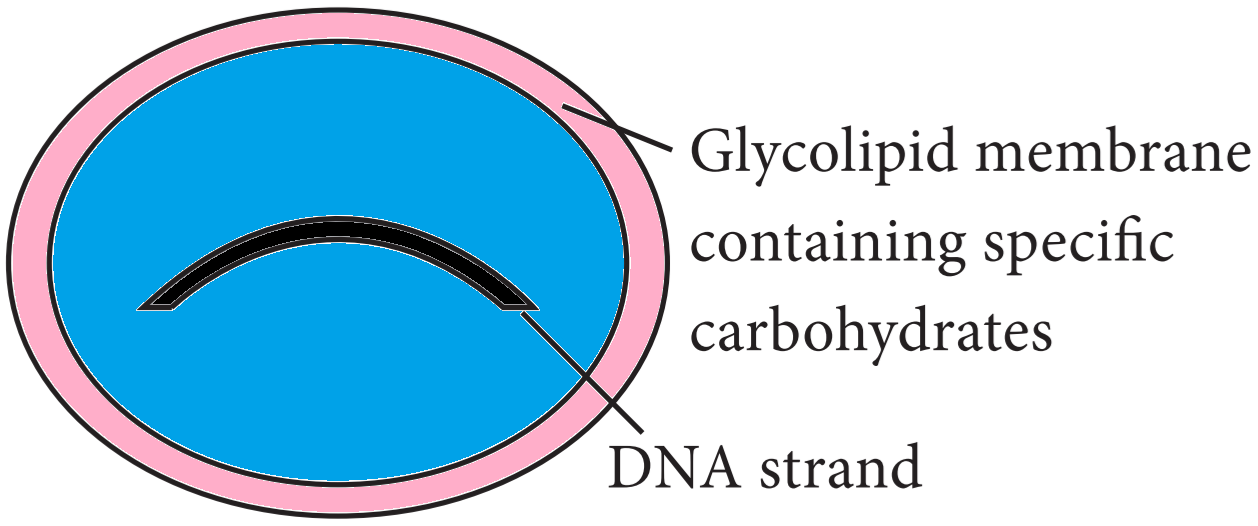
  1. Liposomes can be used for gene therapy as they target the cells affected by a genetic disease. The diagram shows the structure of a liposome.


What feature of a cell surface membrane allows the liposome to target cells affected by a genetic disease?
  1. Carrier molecules.
  2. Phosphate groups.
  3. Protein channels.
  4. Receptor molecules.
  1. Which of the following disorders would gene therapy be least effective?
  1. Cystic fibrosis.
  2. Huntington's disease.
  3. Sickle cell anaemia.
  4. Type II diabetes.
  1. Following are some reasons explaining why gene therapy is not yet fully an effective treatment for genetic diseases.
  1. Lack of knowledge of DNA sequences.
  2. Lack of efficient and safe gene delivery system.
  3. Cost of the technology.
  4. Some diseases involve multiple genes.
  5. Problems with appropriate gene regulation.
Select the correct option.
  1. I, III and V only
  2. II, IV and V only
  3. Ill, IV and V only
  4. I, III and IV only
What is foetal ejection reflex? Explain how it leads to parturition?
Differentiate between homology and analogy. Also discuss the homologous and vestigeal organs with example and how do they explain the evidence of evolution.
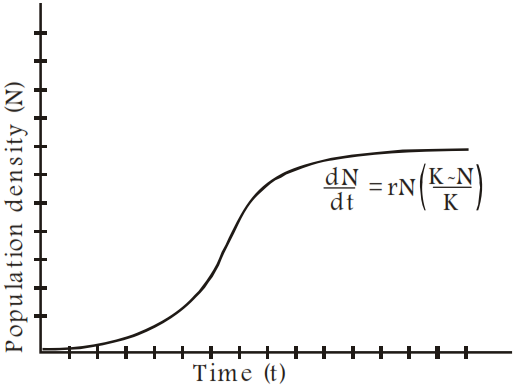
Comment on the growth curve given below.
In a biology class, teacher was telling the students that the structures/components and their functions in a watch can be compared with various levels of organisation we find in nature. Radhika was surprised and asked teacher to explain it. Teacher got impressed with Radhika's interest and explained that there is a systematic arrangement of smaller and simpler components into larger one in a hierarchy or pyramid having different levels where each level is formed of components of lower level and itself becomes part of higher level for achieving a common goal.
(i) What are the four levels of biological organisation found in nature?
(ii) What is the basic unit of ecological organisation?
(iii) Define community.
(iv) What values are shown by Radhika?
The following diagrams are the age pyramids of different populations. Comment on the status of these populations.
  1. Why are engineered vectors preferred?
  2. A vector is engineered with three features, which facilitate its cloning within the host cell. List the three features and explain each one of them.
In one family, the four children each have a different blood group. Their mother has blood group A and their father has blood group B. Work out a cross to explain how it is possible.
What is the difference between transcription in prokaryotic and eukaryotic cells? Compare.