Question
How is ammonia manufactured industrially?

Answer

Ammonia is manufactured industrially by Haber's process.$\text{N}_2(\text{g})+3\text{H}_2(\text{g})\rightleftharpoons2\text{NH}_3(\text{g}) \ \Delta_\text{f}\text{H}^\circ=-46.1\text{KJ mol}^{-1}$
A mixture of dry nitrogen and hydrogen gases in the ratio of $1:3$ by volume is compressed to about $200$ to $300$ atm and passed over iron catalyst at a temperature of about $723$ k to $773$ k. The iron catalyst is mixed with aluminiumoxide $(Al_2O_3)$ and potassium oxide $(K_2O)$ which act as promoters. Ammonia being formed is continuously removed by liquefying it. The optimum conditions for the production of ammonia are a pressure of about $200$ atm, a temperature of $\sim 700$ k and use of a catalyst such as iron oxide with small amounts of $K_2O$ and $Al_2,\ O_3$ to increase the rate of attainment of equilibrium.

Need a full question paper?

Generate a complete, print-ready paper with questions like this in minutes — across 16+ boards, with answer keys.
Start Generating Free

Similar questions

Note: In the following questions a statement of assertion followed by a statement of reason is given. Choose the correct answer out of the following choices.
Assertion: Both rhombic and monoclinic sulphur exist as $S_8$ but oxygen exists as $O_2.$
Reason: Oxygen forms $\text{p}\pi-\text{p}\pi$ multiple bond due to small size and small bond length but $\text{p}\pi-\text{p}\pi$ bonding is not possible in sulphur.
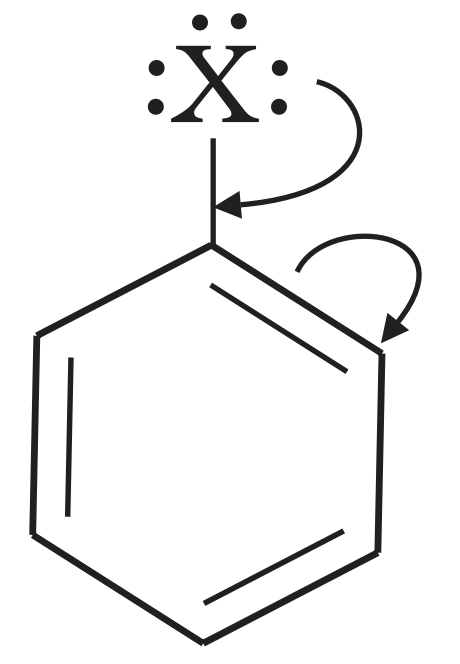
Draw other resonance structures related to the following structure and find out whether the functional group present in the molecule is ortho, para directing or meta directing.
Note: In the following questions a statement of assertion followed by a statement of reason is given. Choose the correct answer out of the following choices.
Assertion: Zone refining method is very useful for producing semiconductors.
Reason: Semiconductors are of high purity.
Explain the observations:
Sun looks red at the time of setting.
Examine the given defective crystal:
$A^+$
$B^-$
$A^+$
$B^-$
$A^+$
$B^-$
$0$
$B^-$
$A^+$
$B^-$
$A^+$
$B^-$
$A^+$
$0$
$A^+$
$B^-$
$A^+$
$B^-$
$A^+$
$B^-$
Answer the following questions:
  1. What type of stoichiometric defect is shown by the crystal?
  2. How is the density of the crystal affected by this defect?
  3. What type of ionic substances show such defect?
What is meant by the term ‘broad spectrum antibiotics’? Explain.
Complete the following reaction equations:
  1. $C_6H_5N_2Cl + H_3PO_2 + H_2O\rightarrow$
  2. $C_6H_5NH_2 + Br_2 (aq.) \rightarrow$
Calculate the number of unpaired electrons in the following gaseous ions: $Mn^{3+}, Cr^{3+}, V^{3+}$ and $Ti^{3+}.$ Which one of these is the most stable in aqueous solution?
Predict the product formed when cyclohexanecarbaldehyde reacts with following reagent.Excess ethanol and acid.
Draw the structure of the following: $XeO_3$