Question
How is an ion different from an atom? How is cation different from anion?
| BASIS FOR COMPARISON | CATION | ANION |
|---|---|---|
| Meaning | An atom or molecule having more number of protons than electrons and are positively charged is called cation. | An atom or molecule having more number of electrons than protons and are negatively charged is called anion. |
| Charge | These are positively charged. | These are negatively charged. |
| Formed of | Cation are formed from metal atoms. | Anion are formed from non-metals atoms. |
| Compounds formed | Cation combine with the anions to form the ionic bonds. | Anion combine with the cations to form the ionic bonds. |
| Electrolysis | Cation always move towards the cathode, which produces the negative charge. | Anion always move towards the anode, which produces the positive charge. |
| Examples | Iron (Fe2+), Sodium (Na+), Lead (Pb2+). | Fluoride (F-), Bromide (Br-), Iodide (I-), Nitride (N3-) and Hydride (H-). |
Generate a complete, print-ready paper with questions like this in minutes — across 16+ boards, with answer keys.
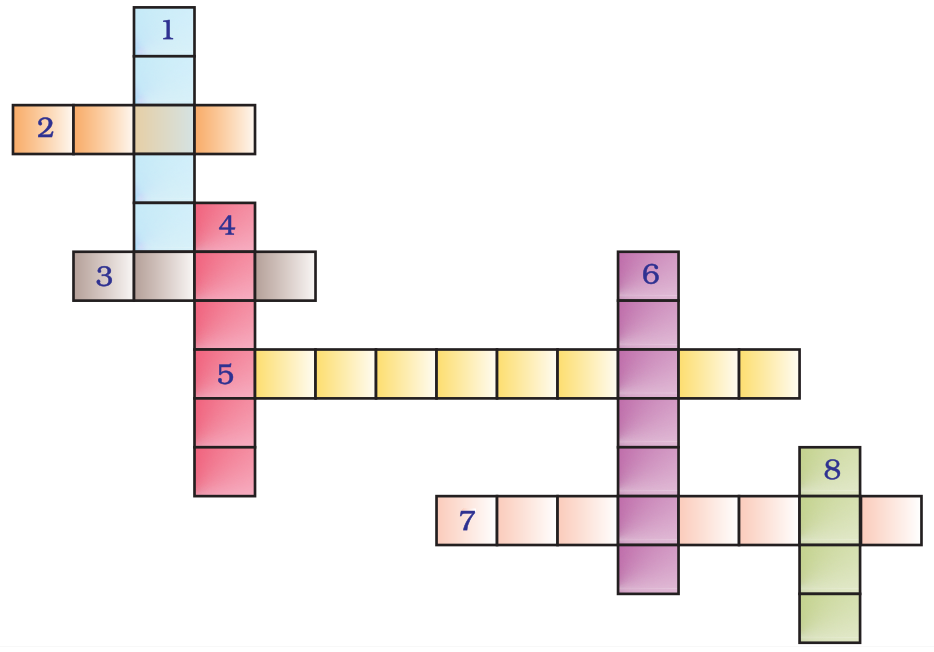
Complete the following crossword puzzle (Figure) by using the name of the chemical elements. Use the data given in the table following.
Across | Down | ||
2. | The element used by Rutherford during his $\alpha$–scattering experiment. | 1. | A white lustrous metal used for making ornaments and which tends to get tarnished black in the presence of moist air. |
3. | An element which forms rust on exposure to moist air. | 4. | Both brass and bronze are alloys of the element. |
5. | A very reactive non–metal stored under water. | 6. | The metal which exists in the liquid state at room temperature. |
7. | Zinc metal when treated with dilute hydrochloric acid produces a gas of this element which when tested with burning splinter produces a pop sound. | 8. | An element with symbol Pb. |
A body of 2kg falls from rest. What will be its kinetic energy during the fall at the end of 2s? (Assume g = 10m/s2)