Question
How is food security ensured in India?

Answer

Food security is ensured in a country when the three dimensions of food security are taken care of. The three dimensions are:
  1. Availability of food − Presence of enough food for all the persons
  2. Accessibility of food − Absence of barrier on access to food
  3. Affordability of food − Capability of all persons to buy food of acceptable quality
Food security has been ensured in India because of the following factors.
  1. Self-sufficiency of food grains − India has become self-sufficient in food grains (as was its aim since Independence) during the last thirty years. This has been because of a variety of crops grown all over the country.
  2. Food-security system − The availability of food grains has been ensured by the government with the help of a carefully designed food-security system. This system involves the maintenance of a buffer stock of food grains, and the distribution of this food among the poorer sections of the society with the help of a public distribution system.
  3. Implementation of several poverty-alleviation programmes having an explicit food security component − Apart from the distribution of food through fair-price shops, the government has come up with several poverty-alleviation programmes that enhance food security; for example, mid-day meals and food-for-work.
  4. Involvement of cooperatives and NGOs − In addition to the role of the government in ensuring food security, various cooperatives and NGOs are also working intensively towards this direction. Mother Dairy and Amul are two examples of cooperatives involved in ensuring food security.

Need a full question paper?

Generate a complete, print-ready paper with questions like this in minutes — across 16+ boards, with answer keys.
Start Generating Free

Similar questions

What is meant by Green Revolution? What are its features?
How was slavery finally abolished in France?
OR
Describe the triangular slave trade that was carried on in the eighteenth and nineteenth centuries. What steps were taken to end slavery in French colonies?
In 2004 a report published in USA pointed to the increasing inequalities in that country. Inequalities in income reflected in the participation of people in democracy. It also shaped their abilities to influence the decisions taken by the government. The report highlighted that:
  • If an average Black family earns $ 100 then the income of average White family is $ 162. A White family has twelve times more wealth than the average Black family.
  • In a President’s election ‘nearly 9 out of 10 individuals in families with income over $ 75,000 have voted. These people are the top 20% of the population in terms of their income. On the other hand only 5 people out of 10 from families with income less than $ 15,000 have voted. They are the bottom 20% of the population in terms of their income.
  • About 95% contribution to the political parties comes from the rich. This gives them opportunity to express their opinions and concerns, which is not available to most citizens.
  • As poor sections participate less in politics, the government does not listen to their concerns − coming out of poverty, getting job, education, health, car and housing for them. Politicians hear most regularly about the concerns of business persons and the rich.
Write an essay on ‘Democracy and Poverty’ using the information given in this report but using examples from India.
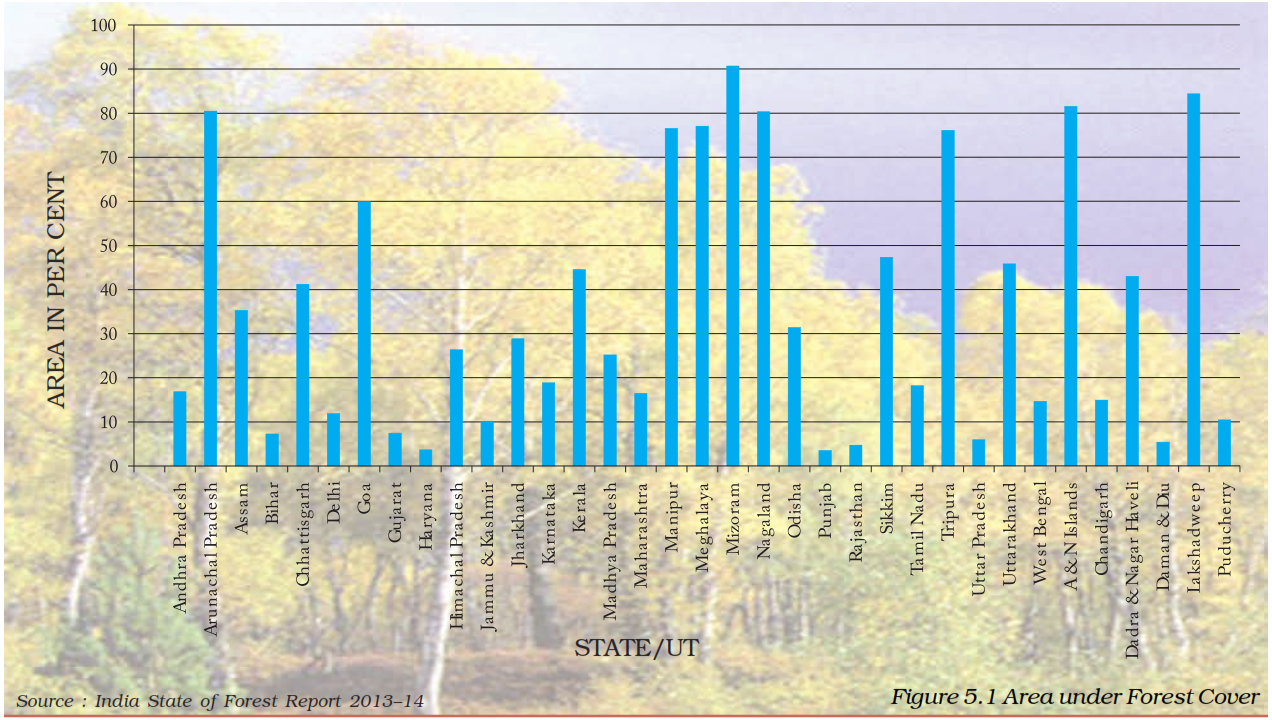
Study the data given and answer the questions given below.
  1. Name two states where the area under forest cover is over 80%.
  2. Name two states where the area under forest cover is below 5%.
  3. What could be the two possible reasons for the forest cover being below 5%?
Write a short note on the National Human Rights Commission.
What are the features of advancing monsoon?
Why do the nomadic tribes need to move from one place to another? What are the advantages to the environment of this continuous movement?
How was forest conservation carried out by the Asian and African countries later on?
What steps have been taken by the government to protect the flora and fauna of the country?
Mention the new rights given to the citizens under the South Africa Constitution.