Maharashtra BoardEnglish MediumSTD 12 SciencePhysicsQuestion Bank [ 2022 ]3 Marks
Question
How is potential gradient measured? Explain.
✓
Answer
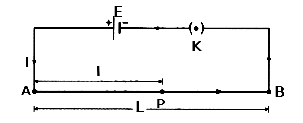
Consider the following potentiometer, which is made up of a long uniform wire $A B$ of length $L$ and resistance $R$ stretched on a wooden board and connected in series with a cell of stable emf $E$ and internal resistance rand a plug key $K$. Let I be the current flowing through the wire when the circuit is closed. Current through $A B, I=\frac{E}{R+r}$ Potential difference across $A B \cdot V_{A B}=I R$ $ \therefore V _{ AB }=\frac{ ER }{ R + r } $ The potential difference (the fall of potential from the high potential end) per unit length of the wire, $ \frac{ V _{ AB }}{ L }=\frac{ ER }{( R + r ) L } $ As long as $E$ and $r$ remain constant, $\frac{ V _{ AB }}{ L }$ will remain constant. $\frac{V_{A B}}{L}$ is known as a potential gradient along with $A B$ and is denoted by K. As a result, the potential gradient is computed by dividing the potential difference between the ends of the potentiometer wire by the wire's length. Let $P$ be any point on the wire between $A$ and $B$ and $A P=I=$ length of the wire between $A$ and $P$. Then $V _{ AP }= Kl$ $\therefore V _{ AP } \propto l$ as $K$ is constant in a particular case. Thus, the potential difference across any length of the potentiometer wire is directly proportional to that length. This is the principle of the potentiometer.
Need a full question paper?
Generate a complete, print-ready paper with questions like this in minutes — across 16+ boards, with answer keys.