Question
How is the electronic configuration of atoms written? Explain with examples.

Answer

SELF

Need a full question paper?

Generate a complete, print-ready paper with questions like this in minutes — across 16+ boards, with answer keys.

Start Generating Free

Similar questions

1. What is the general molecular formula of saturated monohydric alcohols?
2. Write structural formulae for compounds named as-
a. 1-Bromoheptane
b. 5-Bromoheptanoic acid
Match the following prefixes with their multiples:
 
Prefix
Multiples
(i)
micro
$10^6$
(ii)
deca
$10^9$
(iii)
mega
$10^{-6}$
(iv)
giga
$10^{-15}$
(v)
femto
$10$
Explain the following observations:
  1. $CO_2$ and $SO_2$ are not isostructural.
  2. $BF_3$ and $NF_3$ are not isostructural.
  3. $\text{BH}^-_4$ and $\text{NH}^+_4$ are isostructural.
  4. $N_2$ has higher bond order than NO.
  5. In $NO^+$ and $N_2$, the bond order is same.
4 In the alkane $\mathrm{H}_3 \mathrm{C}-\mathrm{CH}_2-\mathrm{C}\left(\mathrm{CH}_3\right)_2-\mathrm{CH}_2-\mathrm{CH}\left(\mathrm{CH}_3\right)_2$, identify $1^{\circ}, 2^{\circ}, 3^{\circ}$ carbon atoms and give the number of H atoms bonded to each one of these.
Distinguish between a sigma and a pi bond.
What do you understand by the term “non-stoichiometric hydrides”? Do you expect this type of the hydrides to be formed by alkali metals? Justify your answer.
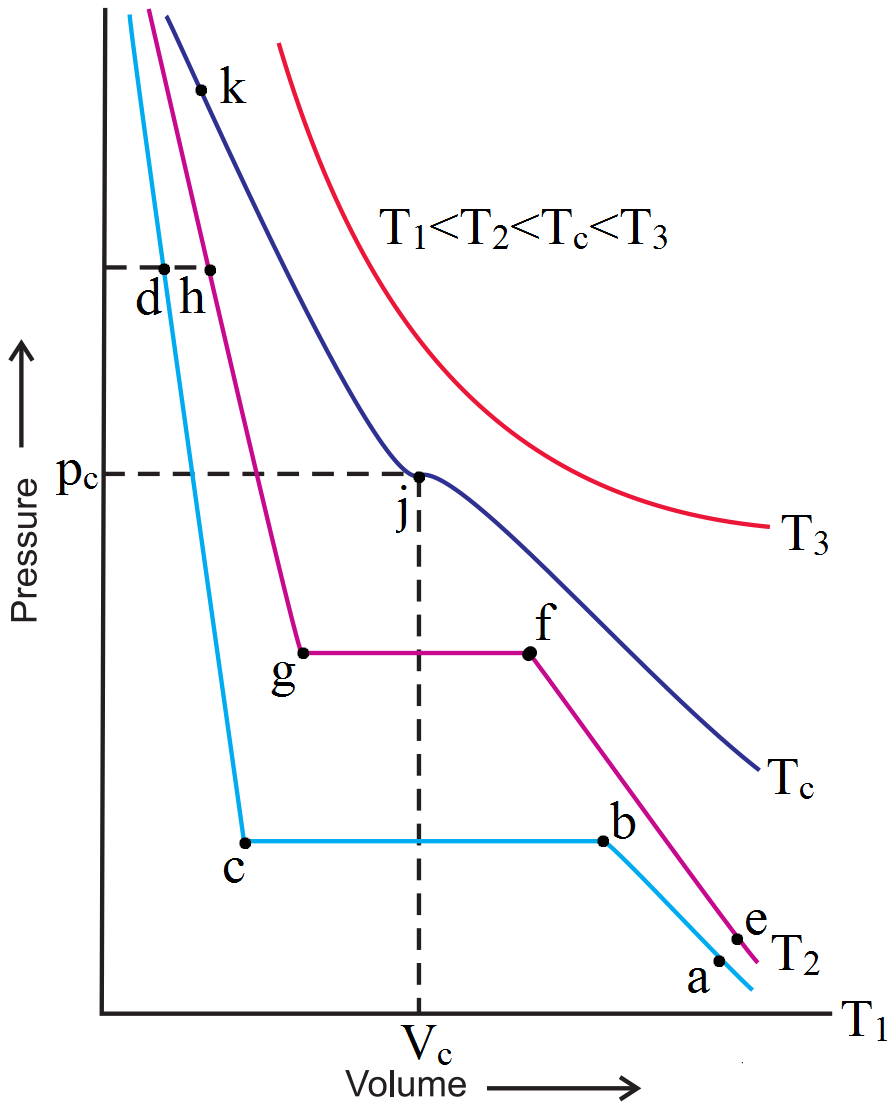
Isotherms of carbon dioxide at various temperatures are represented in the figure. Answer the following questions based on the figure.

i. In which state will $CO _2$ exist between the points a and b at temperature $T _1$ ?
ii. At what point will $CO _2$ start liquefying when temperature is $T _1$ ?
iii. At what point will $CO _2$ be completely liquefied when temperature is $T _2$ ?
iv. Will condensation take place when the temperature is $T_3$ ?
v. What portion of the isotherm at $T _1$ represent liquid and gaseous $CO _2$ at equilibrium?
Explain oxidizing and reducing agents with examples.
  1. Show that the circumference of Bohr's orbit for the H-atom is an integral multiple of the de-Broglie wavelength of electron revolving around the orbit.
  2. Explain that the effect of the Heisenberg uncertainty principle is significant only for motion of microscopic objects and is negligible for that of macroscopic objects. $[h = 6.626 \times 10^{-34}Js$, Mass of electron $= 9.1 \times 10^{-31}kg]$.
  3. State Hund's Rule of maximum multiplicity.
An acidic solution of hydrogen peroxide behaves as an oxidising as well as reducing agent. Illustrate it with the help of a chemical equation.