Question
How is the equilibrium price determined under perfect competition? Explain with the help of a diagram.
OR
Show the determination of market equilibrium with the help of demand and supply schedules and a diagram.

OR
Explain the process of price determination under perfect competition with the help of a schedule and a diagram.
Answer

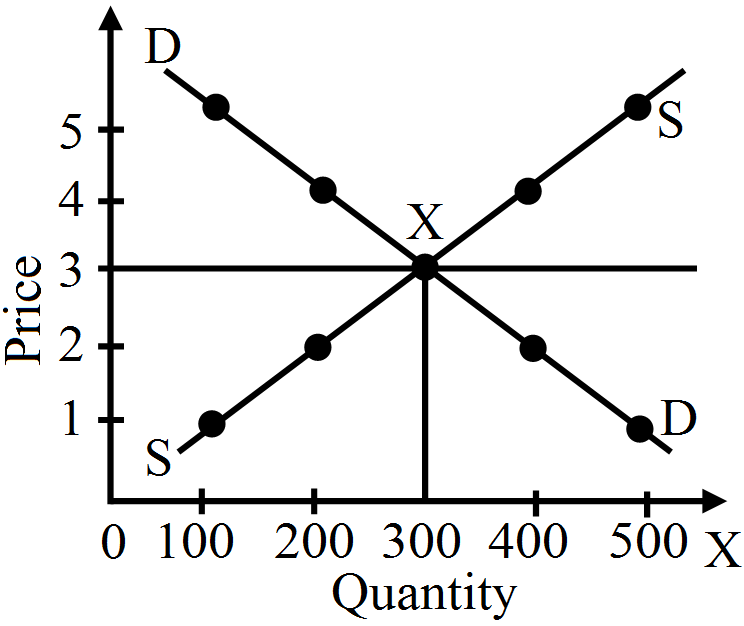
Equilibrium price is determined under perfect competition by the interaction of the forces of demand and supply of a good. It is determined at a point where quantity demanded and quantity supplied of a good are equal. The following schedule and diagram illustrate the determination of equilibrium price:
Price(₹) Demand Supply  
5 100 500  
4 200 400  
3 300 300 Demand = Supply
2 400 200  
1 500 100  

The above table and diagram shows that the given market is in equilibrium at point X in the diagram and the equilibrium price is 3 and the equilibrium quantity is 300 units.

Need a full question paper?

Generate a complete, print-ready paper with questions like this in minutes — across 16+ boards, with answer keys.

Start Generating Free

Similar questions

Giving reasons, state whether the following statements are true or false:
  1. Average cost falls only when marginal cost falls.
  2. The difference between average total cost and average variable cost is constant.
  3. When total revenue is maximum, marginal revenue is also maximum.
Giving reasons, classify the following into fixed costs and variable costs.
  1. Wages to the daily wage workers.
  2. Salary of the permanent staff.
  3. Expenditure on purchase of raw materials.
  4. Interest on borrowed capital.
  5. Electricity Meter rent.
  6. Sales Tax.
Explain the following features of perfect competition:
  1. Large number of buyers and sellers.
  2. Homogeneous products.
Explain the law of variable proportions with the help of total product curve. Use diagram.
A consumer spends ₹ 400 on a good priced at ₹ 4 per unit. When the price rises by 25 percent, the consumer continues to spend ₹ 400. Calculate the price elasticity of demand by percentage method.
From the following schedule, find out the level of output at which the producer is in equilibrium. Give reasons for your answer.
Output (units) Price (₹) Total Cost (₹)
$1$ $24$ $26$
$2$ $24$ $50$
$3$ $24$ $72$
$4$ $24$ $92$
$5$ $24$ $115$
$6$ $24$ $139$
$7$ $24$ $165$
What is the supply curve of a firm in the short run?
From the following schedule find out the level of output at which the producer is in equilibrium. Give reasons for your answer. (Use marginal revenue and marginal cost approach).
Output (Units) MR(₹) TC(₹)
1 8 6
2 6 11
3 4 15
4 2 18
5 0 23
A consumer consumes only two goods X and Y, both priced at Rs. 2 per unit. If the consumer chooses a combination of the two goods with Marginal Rate of Substitution equal to 2, is the consumer in equilibrium? Why or why not? What will a rational consumer do in this situation? Explain.
How will increases in the income of buyers of an 'inferior goods', affect its equilibrium price and equilibrium e quantity? Explain with the help of a E diagram.