Question
How is the presently occurring species extinction different from the earlier mass extinctions?
Answer

Species extinction occurring at present is due to anthropogenic or man-made causes whereas the earlier extinction was due to natural causes.

Need a full question paper?

Generate a complete, print-ready paper with questions like this in minutes — across 16+ boards, with answer keys.

Start Generating Free

Similar questions

A man with blood group A married a woman with blood group B. They have a son with AB blood group and a daughter with blood group O. Work out the cross and show the possibility of such inheritance.
Why is there a statutory ban on amniocentesis? Why is the technique so named?
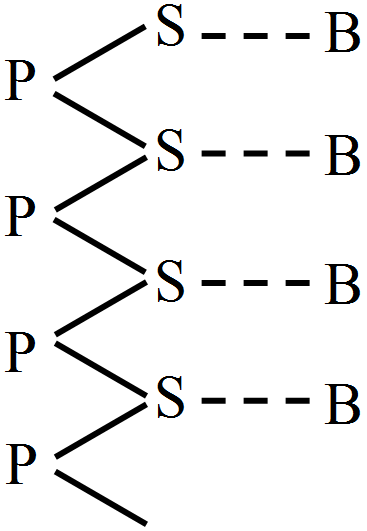
Refer to the following diagram of a strand of nucleotide to answer questions a-d.

  1. What molecule is represented by S?
  2. What molecule is represented by B?
  3. How many different types of B are in DNA?
  4. What type of bond is represented by the dotted lines?
Where do the following events occur in the life-cycle of Plasmodium?
  1. Gametocyte development.
  2. Sexual reproduction.
  3. Asexual reproduction.
List the features that make a stable biological community.
A3' ............ 5'B
C5’ ........... 3'D.
AB and CD represent two strands of a DNA molecule. When this molecule undergoes replication, forming a replication fork between A and C in the above.
  1. Name the templete strand for replication.
  2. Using which strand as the templete, will there be continuous synthesis of a complementary DNA strand
  3. Complementary to which strand will okazaki segments get synthesised, discontinuous synthesis occurs.
  4. What are templete strands and Okazaki pieces?
  5. In which direction is a new strand synthesised?
If a double stranded DNA has 20% of cytosine, calculate the per cent of adenine in the DNA.
Differentiate between Heterochromatin and Euchromatin.
State the measures to prevent AIDS. ### Explain prevention of AIDS.
How is recombinant DNA technology helping in detecting the presence of mutant genes in cancer patients?