MCQ
How many $1,2-$ shift takes place in following carbocation.
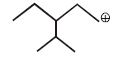
- A$2$
- B$1$
- ✓$3$
- D$4$
Generate a complete, print-ready paper with questions like this in minutes — across 16+ boards, with answer keys.
(Given) $\Delta H^o_f (CaCO_3,s) = -1207 \, \frac{kJ}{mol}$
$\Delta H^o_f \,(CaO,s) = -635 \,kJ/mol$
$\Delta H^o_f \,(CO_2.g) = -394 \,kJ/mol$
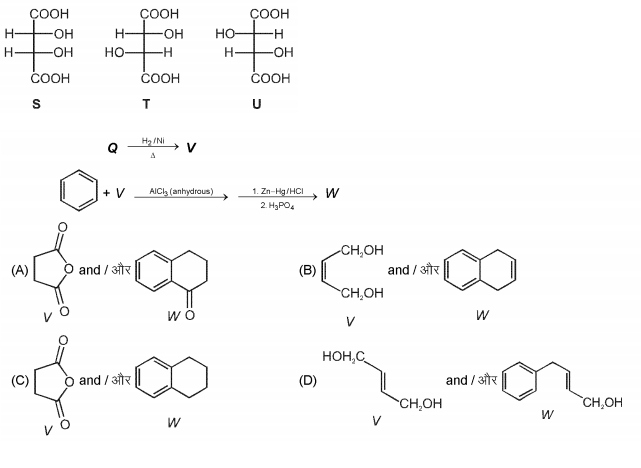
Upon treatment with dilute alkaline $KMnO _4, P$ as well as $Q$ could produce one or more than one from $S , T$ and $U$.$Image$
$1.$ Compounds formed form $P$ and $Q$ are, respectively
$(A)$ Optically active $S$ and optically active pair $(T, U)$
$(B)$ Optically inactive $S$ and optically inactive pair $(T, U)$
$(C)$ Optically active pair $(T, U)$ and optically active $S$
$(D)$ Optically inactive pair $(T, U)$ and optically inactive $S$
$2.$ In the following reaction sequences $V$ and $W$ are respectively :$Image$
mcq $Image$
Give the answer question $1$ and $2.$