Question
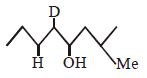
How many chiral carbon atoms are present in following compound :-
Generate a complete, print-ready paper with questions like this in minutes — across 16+ boards, with answer keys.
| Rate $mol\,L^{-1}\,s^{-1}$ | $[A]$ $mol\,L^{-1}$ | $[B]$ $mol\,L^{-1}$ |
| $0.10$ | $20$ | $0.5$ |
| $0.40$ | $x$ | $0.5$ |
| $0.80$ | $40$ | $y$ |
What is the value of $x$ and $y ?$
| LIST-I | LIST-II | ||
| A. | Glucose //NaHCO_(3)//Delta | I. | Gluconic acid |
| B. | Glucose/ HNO_(3) | II. | No reaction |
| C. | Glucose //HI//Delta | III. | n-hexane |
| D. | Glucose // Bromine water] | IV. | Saccharic acid |

$\Delta {H^o}\, = \, +234.1\,\,kJ$
$C(s)\, + {O_2}(g)\, \to \,\,C{O_2}(g)$
Use these equation and $\Delta H^o$ value to calculate $\Delta H^o$ for this reaction:
$4Fe(s) + 3O_2(g) \to 2Fe_2O_3(s)$
.....$kJ$