MCQ
How many collision are possible between the blocks?
  • A
    2
  • B
    4
  • C
    27
  • D
    infinite

Answer

  1. infinite

Explanation:

As the distance keeps on decreasing  and there will be a deceleration in the blocks.

In further results,   collision increases frequently many times  and slowly come in contact.

Need a full question paper?

Generate a complete, print-ready paper with questions like this in minutes — across 16+ boards, with answer keys.
Start Generating Free

Similar questions

The rms speed of oxygen molecules in a gas is v. If the temperature is doubled and the oxygen molecules dissociate into oxygen atoms, the rms speed will become:
Assume that a tunnel is dug along a chord of the earth, at a perpendicular distance $( R / 2)$ from the earth's centre, where $'R'$ is the radius of the Earth. The wall of the tunnel is frictionless. If a particle is released in this tunnel, it will execute a simple harmonic motion with a time period
Young's modulus is determined by the equation given by $\mathrm{Y}=49000 \frac{\mathrm{m}}{\ell} \frac{\text { dyne }}{\mathrm{cm}^2}$ where $\mathrm{M}$ is the mass and $\ell$ is the extension of wre used in the experiment. Now error in Young modules $(\mathrm{Y})$ is estimated by taking data from $M-\ell$ plot in graph paper. The smallest scale divisions are $5 \mathrm{~g}$ and $0.02$ $\mathrm{cm}$ along load axis and extension axis respectively. If the value of $M$ and $\ell$ are $500 \mathrm{~g}$ and $2 \mathrm{~cm}$ respectively then percentage error of $\mathrm{Y}$ is :
If the sum of two unit vectors is also a unit vector. then magnitude of their difference and angle between the two given unit vectors is ..............
One mole of a gas obeying the equation of state $P(V-b)=R T$ is made to expand from a state with coordinates $\left(P_{1}, V_{1}\right)$ to a state with $\left(P_{2}, V_{2}\right)$ along a process that is depicted by a straight line on a $P-V$ diagram. Then, the work done is given by
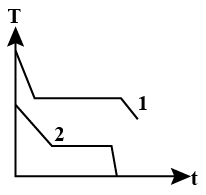
Two different liquids of same mass are kept in two identical vessels, which are placed in a freezer that extracts heat from them at the same rate causing each liquid to transform into a solid. The schematic figure below shows the temperature $T$ versus time $t$ plot for the two materials. We denote the specific heat in the liquid states to be $C_{L 1}$ and $C_{L 2}$ for materials 1 and 2, respectively and latent heats of fusion $U_1$ and $U_2$, respectively. Choose the correct option.
The displacement of a ball falling from rest in a viscous medium is platted against time. Choose a possible option
The retarding acceleration of $7.35\, ms^{-2}$ due to frictional force stops the car of mass $400\, kg$ travelling on a road. The coefficient of friction between the tyre of the car and the road is
If wavelength of maximum intensity of radiation emitted by Sun and Moon are $0.5 \times 10^{-4} \,m$ and $10^{-4}\,m$ respectively, then the ratio of their temperature is ............
A body is projected from earth's surface to become its satellite. Its time period of revolution will not depend upon: