MCQ
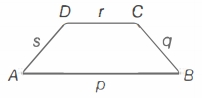
How many different (mutually non-congruent) trapeziums can be constructed using four distinct side lengths from the set $\{1,2,3,4,5,6\}$ ?
  • A
    $5$
  • $11$
  • C
    $15$
  • D
    $30$

Answer

Correct option: B.
$11$
b
(b)

Length of sides of trapezium from $\{1,2,3$, $4,5,6\}$.

From non-congruent trapezium

$|a-c| < b+d < a+c$

Possible combination are

$(r, p),(s, q) \equiv\{(5,6),(1,3)\},\{(5,6),(2,4)\}$

$\{(5,6),(1,4)\},\{(5,6),(3,4)\},\{(6,4),(1,3)\}$,

$\{(6,4),(1,5)\},\{(6,4),(2,3)\},\{(6,4),(3,5)\}$

$\{(4,5),(1,3)\}\{(4,5),(1,6)\}\{(4,5),(2,6)\}$

Total $11$ combination is possible.
Need a full question paper?

Generate a complete, print-ready paper with questions like this in minutes — across 16+ boards, with answer keys.

Start Generating Free

Similar questions

Cards are drawn one by one at random from a well shuffled full pack of $52$ cards until two aces are obtained for the first time. If $N$ is the number of cards required to be drawn, then ${P_r}\{ N = n\} ,$ where $2 \le n \le 50,$ is
If $y = {\log _{10}}x + {\log _x}10 + {\log _x}x + {\log _{10}}10,$ then ${{dy} \over {dx}} = $
Let $f:R \to R$ be a differentiable function having $f(2) = 6,f'(2) = \left( {\frac{1}{{48}}} \right).$ Then $\mathop {\lim }\limits_{x \to 2} \int\limits_6^{f(x)} {\frac{{4{t^3}}}{{x - 2}}} dt$ equals
Solution of the differential equation $xdy = (y + xy^3 (1 + log_ex))\ dx$ is (Where $C$ is arbitary constant)
If $n$ is a factor of $72$ , such that $xy = n$ , then number of ordered pairs $(x, y)$ are :- (where $x$ , $y \in  N$ )
If $y=y(x)$ is the solution curve of the differential equation $x^{2} d y+\left(y-\frac{1}{x}\right) d x=0 \quad ; x>0$ and $\mathrm{y}(1)=1$, then $\mathrm{y}\left(\frac{1}{2}\right)$ is equal to :
The new coordinates of a point $(4, 5)$, when the origin is shifted to the point $(1,-2)$ are
Given vertices $A(1,\,1),B(4,\, - 2)$ and $C(5,\,5)$ of a triangle, then the equation of the perpendicular dropped from $C$ to the interior bisector of the angle $A$ is
A triangle is formed by the tangents at the point $(2,2)$ on the curves $y^2=2 x$ and $x^2+y^2=4 x$, and the line $x+y+2=0$. If $r$ is the radius of its circumcircle, then $r ^2$ is equal to $........$.
The position vectors of $A$  and $B$  are $2i - 9j - 4k$ and $6i - 3j + 8k$ respectively, then the magnitude of $\overrightarrow {AB} $ is