MCQ
How many different (mutually non-congruent) trapeziums can be constructed using four distinct side lengths from the set $\{1,2,3,4,5,6\}$ ?
- A$5$
- ✓$11$
- C$15$
- D$30$
Length of sides of trapezium from $\{1,2,3$, $4,5,6\}$.
From non-congruent trapezium
$|a-c| < b+d < a+c$
Possible combination are
$(r, p),(s, q) \equiv\{(5,6),(1,3)\},\{(5,6),(2,4)\}$
$\{(5,6),(1,4)\},\{(5,6),(3,4)\},\{(6,4),(1,3)\}$,
$\{(6,4),(1,5)\},\{(6,4),(2,3)\},\{(6,4),(3,5)\}$
$\{(4,5),(1,3)\}\{(4,5),(1,6)\}\{(4,5),(2,6)\}$
Total $11$ combination is possible.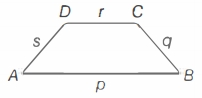
Generate a complete, print-ready paper with questions like this in minutes — across 16+ boards, with answer keys.
[Where $n$ is an integer]
Let the circles $C_1: x^2+y^2=9$ and $C_2:(x-3)^2+(y-4)^2=16$, intersect at the points $X$ and $Y$. Suppose that another circle $C_3:(x-h)^2+(y-k)^2=r^2$ satisfies the following conditions :
$(i)$ centre of $C _3$ is collinear with the centres of $C _1$ and $C _2$
$(ii)$ $C _1$ and $C _2$ both lie inside $C _3$, and
$(iii)$ $C _3$ touches $C _1$ at $M$ and $C _2$ at $N$.
Let the line through $X$ and $Y$ intersect $C _3$ at $Z$ and $W$, and let a common tangent of $C _1$ and $C _3$ be a tangent to the parabola $x^2=8 \alpha y$.
There are some expression given in the $List-I$ whose values are given in $List-II$ below:
| $List-I$ | $List-II$ |
| $(I)$ $2 h + k$ | $(P)$ $6$ |
| $(II)$ $\frac{\text { Length of } ZW }{\text { Length of } XY }$ | $(Q)$ $\sqrt{6}$ |
| $(III)$ $\frac{\text { Area of triangle } MZN }{\text { Area of triangle ZMW }}$ | $(R)$ $\frac{5}{4}$ |
| $(IV)$ $\alpha$ | $(S)$ $\frac{21}{5}$ |
| $(T)$ $2 \sqrt{6}$ | |
| $(U)$ $\frac{10}{3}$ |
($1$) Which of the following is the only INCORRECT combination?
$(1) (IV), (S)$ $(2) (IV), (U)$ $(3) (III), (R)$ $(4) (I), (P)$
($2$) Which of the following is the only CORRECT combination?
$(1) (II), (T)$ $(2) (I), (S)$ $(3) (I), (U)$ $(4) (II), (Q)$
Give the answer or quetion ($1$) and ($2$)