Question
How many five-digit numbers formed using the digit 0, 1, 2, 3, 4, 5 are divisible by 3 if digits are not repeated?

Answer

For a number to be divisible by 3.
The sum of digits must be divisible by 3.
Given 6 digits are 0, 1,2, 3, 4, 5.
Sum of 1, 2, 3, 4, 5 = 15, which is divisible by 3.
∴ There are two cases of 5 digit numbers formed from 0, 1, 2, 3, 4, 5 and divisible by 3.
Either 3 is selected in 5 digits (and 0 not selected) or 3 is not selected in 5 digits (and 0 is selected)
Case I:
3 is not selected (and 0 is selected) i.e., the digits are 0, 1, 2, 4, 5.
10000’s place digit can be selected in 4 ways (as 0 cannot appear).
As digits are not repeated, 1000’s place digit can be selected in 4 ways.
100’s place digit can be selected in 3 ways.
10’s place digit can be selected in 2 ways.
The unit’s place digit can be selected in 1 way.
∴ Using multiplication theorem,
Number of 5-digit number formed from 0, 1, 2, 4, 5 (with no repetition of digits) = 4 × 4 × 3 × 2 × 1 = 96

Case II:
3 is selected (and 0 is not selected) i.e., 1, 2, 3, 4, 5
10000’s place digit can be selected in 5 ways.
1000’s place digit can be selected in 4 ways.
100’s place digit can be selected in 3 ways.
10’s place digit can be selected in 2 ways.
The unit’s place digit can be selected in 1 way.
Using multiplication theorem,
Number of 5-digit numbers formed from 1, 2, 3, 4, 5 = 5 × 4 × 3 × 2 × 1 = 120
Both the cases are mutually exclusive and exhaustive.
∴ Required number = 96 + 120 = 216

Need a full question paper?

Generate a complete, print-ready paper with questions like this in minutes — across 16+ boards, with answer keys.
Start Generating Free

Similar questions

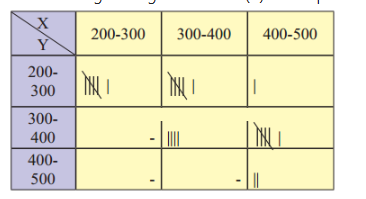
The following table gives income (X) and expenditure (Y) of 25 families:

Image

Find
(i) Marginal frequency distributions of income and expenditure.
(ii) Conditional frequency distribution of X when Y is between 300 – 400.
(iii) Conditional frequency distribution of Y when X is between 200 – 300.
(iv) How many families have their income ₹ 300 and more and expenses ₹ 400 and less?

Express the following recurring decimals as a rational number: $0.3 \overline{45}$
The vertices of a triangle are $A(1,4), B(2,3)$, and $C(1,6)$. Find equations of : Perpendicular bisectors of sides
A man gets a simple interest of $₹ 2,000$ on a certain principal at the rate of $5 \%$ p.a. in 4 years. What compound interest will the man get on twice the principal in 2 years at the same rate.
Find five numbers in G.P. such that their product is 243 and the sum of the second and fourth numbers is 10.
Construct a bivariate frequency distribution table of the marks obtained by students in Statistics (X) and English (Y).

Marks in statistics (x)

37

20

46

28

35

26

41

48

32

23

20

39

47

33

27

26

Marks in english (y)

30

32

41

33

29

43

30

21

44

38

47

24

32

31

20

21

Construct a bivariate frequency distribution table for the above data by taking class intervals 20 – 30, 30 – 40, …. etc. for both X and Y. Also find the marginal distributions and conditional frequency distribution of Y when X lies between 30 – 40.

Find the value of : $x^3-3 x^2+19 x-20$, if $x=1-4 i$
Vaishnavi bought 1000, ₹ 100 shares from the stock market carrying $8 \%$ dividend quoted at ₹ 130. A few days later the market value of the shares went up by $10 \%$. Vaishnavi sold all her shares. What was her total income from this transaction?
The following frequency distribution shows the weight of students in a class.
Weight (In Kg)404550556065
No. Of Student15402921105

(a) Find the percentage of students whose weight is more than 50 kg.
(b) If the weight column provided is of mid values then find the percentage of students whose weight is more than 50 kg.

Evaluate the following limits:

$\lim _{x \rightarrow a}\left[\frac{\sqrt{a+2 x}-\sqrt{3 x}}{\sqrt{3 a+x}-2 \sqrt{x}}\right]$