MCQ
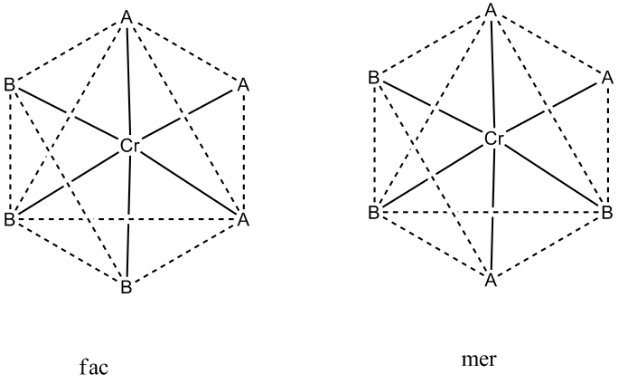
How many geometrical Isomers are possible for complex ${\left[ {M{a_3}{b_3}} \right]^{ \pm n}}$ ?
- A$5$
- B$4$
- ✓$2$
- D$6$
Generate a complete, print-ready paper with questions like this in minutes — across 16+ boards, with answer keys.
$\mathrm{Cu}_{(\mathrm{s})}+2 \mathrm{Ag}^{+}\left(1 \times 10^{-3} \,\mathrm{M}\right) \rightarrow \mathrm{Cu}^{2+}(0.250\, \mathrm{M})+2 \mathrm{Ag}_{(\mathrm{s})}$
$\mathrm{E}_{\mathrm{Cell}}^{\ominus}=2.97\, \mathrm{~V}$
$\mathrm{E}_{\text {cell }}$ for the above reaction is $....\,V.$ (Nearest integer)
[Given : $\log 2.5=0.3979, T=298\, \mathrm{~K}]$
|
List $I$ (Anion) |
List $II$ $($Gas evolved on reaction with dil $H _{2} SO _{4})$ |
| $A.$ $CO _{3}^{2-}$ | $I.$ Colourless gas which turns lead acetate paper black |
| $B.$ $S^{2-}$ | $II.$ Colourless gas which turns acidified potassium dichromate solution green. |
| $C.$ $SO_{3}{ }^{2-}$ | $III.$ Brown fumes which turns acidified KI solution containing starch blue. |
| $D.$ $NO _{2}^{-}$ | $IV.$ Colourless gas evolved with brisk effervescence, which turns lime water milky. |
Choose the correct answer from the options given below
|
सूची-$I$ coordination compounds |
सूची-$II$ numbar of unpaired electrons |
| $A$ $\left[ Cr ( CN )_6\right]^{3-}$ | $I$ $0$ |
| $B$ $\left[ Fe \left( H _2 O \right)_6\right]^{2+}$ | $II$ $3$ |
| $C$ $\left[ Co \left( NH _3\right)_6\right]^{3+}$ | $III$ $2$ |
| $D$ $\left[ Ni \left( NH _3\right)_6\right]^{2+}$ | $IV$ $4$ |
Choose the correct answer from the options given below :-
$CH_3-COOH$ $\mathop {\xrightarrow{{(i)\,B{r_2}/P}}}\limits_{(ii)\,NaCN\,(iii)\,{H_2}O/{H^ \oplus }/\Delta } \,[X]$
$[X]$ will be :
$ {I_2} + 2{e^ - } \to \,2{I^ - }\,;\,\,{E^o}\, = \,\,0.54\,\,V $
$ MnO_4^ - \, + \,8{H^ + }\, + \,5{e^ - } \to \,M{n^{2 + }}\, + \,4{H_2}O\,;\,{E^{o\,}} = 1.52\,\,V $
$ F{e^{3 + }} + {e^ - } \to \,\,F{e^{2 + }}\,;\,\,{E^o}\, = \,\,0.77\,\,V $
$ S{n^{4 + }} + 2{e^ - } \to \,\,S{n^{2 + }}\,;\,\,{E^o}\, = \,\,0.1\,\,V $
The strongest reducant and oxidant respectively are