MCQ
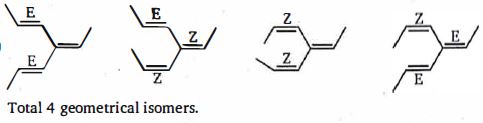
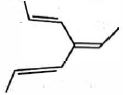
How many geometrical isomers are possible for the above compound ?
  • A
    $3$
  • $4$
  • C
    $6$
  • D
    $8$

Answer

Correct option: B.
$4$
b

Need a full question paper?

Generate a complete, print-ready paper with questions like this in minutes — across 16+ boards, with answer keys.

Start Generating Free

Similar questions

Which one of the following reactions will not result in the formation of carbon-carbon bond?
Mass and energy are conserved is demonstrated by
Which element has maximum electron affinity
The Henry's law constant for the solubility of $N_2$ gas in water at $298\,K$ is $1.0 \times 10^5\, atm$. The mole fraction of $N_2$ in air is $0.8$. The number of moles of $N_2$ from air dissolved in $10\,moles$ of water at $298\,K$ and $5\,atm$ pressure will be
Which is wrong statement?
(image) $\xrightarrow{{Cr{O_3}}}A\xrightarrow[{{H^ \oplus }/{H_2}O}]{{C{H_3}MgBr}}B\xrightarrow[\Delta ]{{{H_2}S{O_4}}}C\xrightarrow[{{H_2}{O_2},O{H^\Theta }}]{{{B_2}{H_6}}}D$
The entropy of a sample of a certain substance increases by $0.836\,J\,K^{-1}$ on adding reversibly $0.3344\,J$ of heat at constant temperature. The temperature of the sample is.....$K$
The compound $HCl$  behaves as …. in the reaction, $HCl + HF \to H_2^ + Cl + {F^ - }$
Equilibrium constants for the following reactions are given (pressure in atm) for the reactions at  $0\,^o C$. Select the option mentioning correct order of True $(T)$ or False $(F)$ statement

$A.6{H_2}{O_{\left( s \right)}} \rightleftharpoons A.2{H_2}{O_{(s)}} + \mathop {4{H_2}{O_{(g)}}};{{K_P} = 1.6 \times {{10}^{ - 11}}} $

$B.12{H_2}{O_{\left( s \right)}} \rightleftharpoons B.7{H_2}{O_{(s)}} + \mathop {5{H_2}{O_{(g)}}};{{K_P} = 2.43 \times {{10}^{ - 13}}} $

$B.10{H_2}{O_{\left( s \right)}} \rightleftharpoons {C_{(s)}} + \mathop {10{H_2}{O_{(g)}}};{{K_P} = {{10}^{ - 30}}} $

Aqueous tension of $H_2O$ at $0\,^oC$ is given as $0.76\  torr$

$(I)$ The most effective drying agent will be $C_{(s)}$. Out of $C_{(s)}$ , $B. 7H_2O_{(s)}$ & $A. 2H_2O_{(s)}$

$(II)$ At $0\,^oC$, $A.6H_2O_{(s)}$ & $B.12H_2O_{(s)}$ will

$(III)$ If $R.H$ is less than $100\%$ in a chamber at $0\,^oC$, then none of the substance can act as deliquescent

Which of the following is considered as an anticancer species.