MCQ
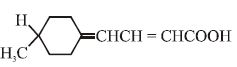
How many isomers are possible for the following molecule ?
  • A
    $1$
  • B
    $2$
  • C
    $3$
  • D
    $4$

Answer

Need a full question paper?

Generate a complete, print-ready paper with questions like this in minutes — across 16+ boards, with answer keys.

Start Generating Free

Similar questions

For the reaction 

$CO(g) + H_2O(g)  \rightleftharpoons  CO_2(g) + H_2(g)$, at a given temperature, the equilibrium amount of $CO_2(g)$ can be increased by

In the thermal decomposition of potassium chlorate given as ,

$2K\,Cl{O_3}\xrightarrow{{}}2KCl + 3{O_2}$   law of mass action
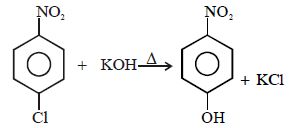
The following reaction is
If $X$  is the specific resistance of the solution and $M$  is the molarity of the solution, the molar conductivity of the solution is given by
The following bimolecular elimination reaction $(E_2)$ is carried out with different  halogen leaving groups. The per cent yield of the two products ($2$ -hexene and $1$-hexene) for each leaving group is listed below.

Leaving group Conj. Acid $pK_a$ $\%$ -yield of $2$-hexene $\%$ -yield of $1$ -hexene
$X = I$ $- 10$ $81\%$ $19\%$
$X = Br$ $-9$ $72\%$ $28\%$
$X = Cl$ $-7$ $67\%$ $33\%$
$X = F$ $3.2$ $30\%$ $70\%$

Which of the following statement is (are) true concerning this series of $E_2$ reactions ?

$\begin{array}{*{20}{c}}
  {C{H_3} - CH - C{O_2}K} \\ 
  {|\,\,\,\,\,\,\,\,} \\ 
  {C{H_3} - CH - C{O_2}K} 
\end{array}\xrightarrow{{electrolysis}}(A)\,(Major)$

Major product $(A)$ of the above reaction

Power alcohol is
The ionization enthalpy of hydrogen atom is $1.312 \times 10^6\, J\, mol^{-1}.$ The energy required to excite the electron in the atom from $n= 1$ to $n=2$ is
The highest value of the calculated spin-only magnetic moment (in $BM$) among all the transition metal complexes is
For the reaction

${N_2}{O_4}(g) \rightleftharpoons 2N{O_2}(g),\,\,\frac{{{K_c}}}{{{K_p}}}$ is