MCQ
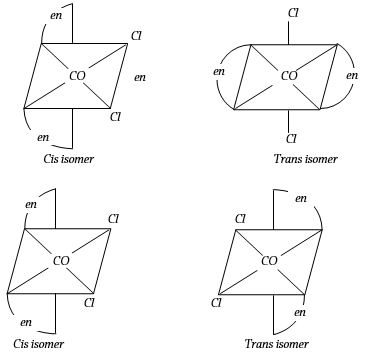
How many isomers are possible in $[Co{(en)_2}C{l_2}]$
  • A
    $2$
  • $4$
  • C
    $6$
  • D
    $1$

Answer

Correct option: B.
$4$
b
(b) $[Co{(en)_2}C{l_2}]$ has $2$ geometrical isomers & $2$ optical isomers.

Again Cis isomer can give $2$ optical isomers.
Need a full question paper?

Generate a complete, print-ready paper with questions like this in minutes — across 16+ boards, with answer keys.

Start Generating Free

Similar questions

Which of the following $0.1\,M$  solution will contain the largest concentration of hydronium ions
Which of the following combination of statements is true regarding the interpretation of the atomic orbitals?

$(1)$ An electron in an orbital of high angular momentum stays away from the nucleus than an electron in the orbital of lower angular momentum.

$(2)$ For a given value of the principal quantum number, the size of the orbit is inversely proportional to the azimuthal quantum number

$(3)$ According to wave mechanics, the ground state angular momentum is equal to $\frac {h}{2\pi }$

$(4)$ The plot of $\Psi \,\,Vs\,\,r$ for various azimuthal quantum numbers, shows peak shifting towards higher $r$ value

Which of the following compounds can be best prepared by Wurtz reaction?
The solubility product of a sparingly soluble salt $AB$ at room temperature is $1.21 \times {10^{ - 6}}$. Its molar solubility is
Methyl vinyl ketone on reaction with $LiCuMe_2$ gives a major product, whose  structure is
The reaction, $2S{O_{2(g)}} + {O_{2(g)}}$ $\rightleftharpoons$ $2S{O_{3(g)}}$ is carried out in a $1$ $d{m^3}$ vessel and $2\;d{m^3}$ vessel separately. The ratio of the reaction velocities will be
Which of the following is least ionic ?
The electronic configuration of Curium (Atomic number $96$) is
Sugar which does not give reddish brown precipitate with Fehling‟s reagent is:
When $400\, \mathrm{~mL}$ of $0.2\, \mathrm{M} \,\mathrm{H}_{2} \mathrm{SO}_{4}$ solution is mixed with $600\, \mathrm{~mL}$ of $0.1\, \mathrm{M} \,\mathrm{NaOH}$ solution, the increase in temperature of the final solution is $....\,\times 10^{-2} \,\mathrm{~K}$. (Round off to the Nearest Integer).

$\left[\right.$ Use $: \mathrm{H}^{+}(\mathrm{aq})+\mathrm{OH}^{-}(\mathrm{aq}) \rightarrow \mathrm{H}_{2} \mathrm{O}: \Delta_{\mathrm{\gamma}} \mathrm{H}=-57.1\, \mathrm{k} \mathrm{J} \,\mathrm{mol}^{-1}$

Specific heat of $\mathrm{H}_{2} \mathrm{O}=4.18 \mathrm{Jk}^{-} \mathrm{g}^{-}$

density of $\mathrm{H}_{2} \mathrm{O}=1.0\, \mathrm{~g} \mathrm{~cm}^{-3}$

Assume no change in volume of solution on mixing.]