Question
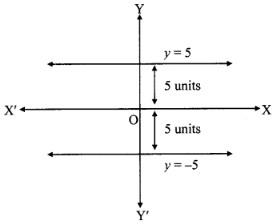
How many lines are there which are parallel to X-axis and having a distance 5 units?
Answer

The equation of a line parallel to the X-axis is y = b.
There are 2 lines which are parallel to X-axis and at a distance of 5 units.
Their equations are y = 5 and y = -5.

Image

Need a full question paper?

Generate a complete, print-ready paper with questions like this in minutes — across 16+ boards, with answer keys.
Start Generating Free

Similar questions

The ratio between the radius of the base and the height of a cylinder is $2:3$.
Find the total surface area of the cylinder, if its volume is $1617cm^2.$
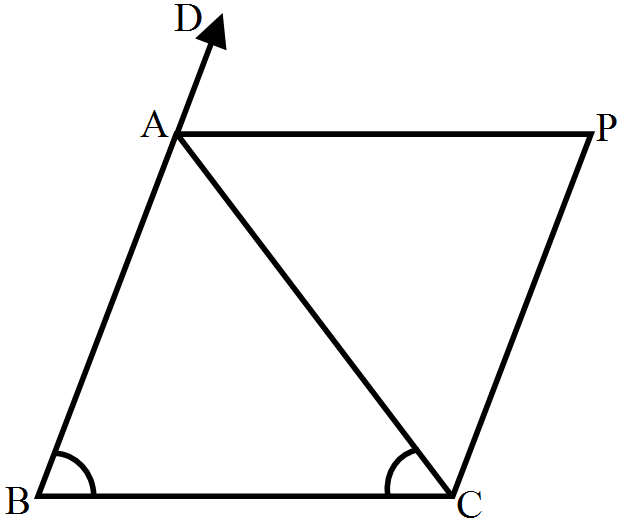
In figure, AB = AC and CP ∥ BA and AP is the bisector of exterior $\angle\text{CAD}$ of $\triangle\text{ABC}.$ Prove that:
  1. $\angle\text{PAC}=\angle\text{BCA}.$
  2. ABCP is a parallelogram.
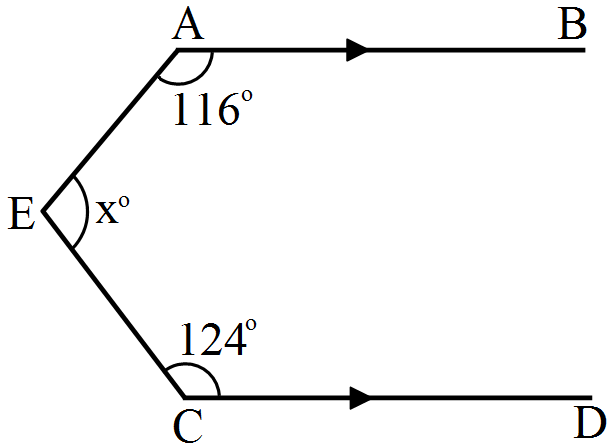
In the figure given below, AB || CD. Find the value of x in each case.
The following data shows the average age of men in various countries in a certain year.
Country
India
Nepal
China
Pakistan
U.K
U.S.A
Average age (in years)
55
52
60
50
70
75
Represent the above information by a bar graph.
The following table gives the distribution of IQ's (intelligence quotients) of 60 pupils of class V in a school:
IQ's:
125.5 to 13.25
118 to 125.5
111.5 to 118.5
104.5 to 111.5
97.5 to 104.5
90.5 to 97.5
83.5 to 90.5
76.5 to 83.5
69.5 to 76
62.5 to 69.5
No. of pupils:
1
3
4
6
10
12
15
5
3
1
Draw a frequence polygon for the above data.
The dimentional of rectangular box are inthe ratio of $2: 3: 4$ and the difference between the cost of covering it with sheet of paper at the rates of $₹ 8$ and $₹ 9.50$ per $m ^2$ is $₹ 1248$. Find the dimensions of the box.
It is required to make a closed cylindrical tank of height 1m and the base diameter of 140cm from a metal sheet. How many square meters of the sheet are required for the same?
Write the class size and class limits in the following:
47, 52, 57, 62, 67, 72, 78, 82, 87, 92, 97, 102.
P is a point on the bisector of $\angle\text{ABC}.$ If the line through P, parallel to BA meets BC at Q, prove that $\triangle\text{BPQ}$ is an isosceles triangle.
A triangle and a parallelogram have the same base and the same area. If the sides of the triangle are $13 cm, 14 cm$ and 15 cm and the parallelogram stands on the base 14 cm , find the height of a parallelogram.