MCQ
How many molecules are present in one gram of hydrogen........ $\times {10^{23}}$
  • A
    $6.02$
  • $3.01$
  • C
    $2.5$
  • D
    $1.5$

Answer

Correct option: B.
$3.01$
b
(b) $2\,gm$ of hydrogen $ = 6.02 \times {10^{23}}$molecules

$\therefore $ $1\,gm$ of hydrogen $ = \frac{{6.02 \times {{10}^{23}}}}{2} = 3.01 \times {10^{23}}$ molecule.

Need a full question paper?

Generate a complete, print-ready paper with questions like this in minutes — across 16+ boards, with answer keys.

Start Generating Free

Similar questions

Which property of an element is always a whole number
Which of the following phosphorus is most stable
For the following compounds, choose the incorrect option ? 

$\mathop {C{H_3} - N{H_2}}\limits_{(P)} \,\,\,\,\,\,\,\,\,\,\,\mathop {Ph - N{H_2}}\limits_{(Q)} $

............ grams of $NaOH$ will be required to neutralize $12.2\,grams$ of benzoic acid
In a $500\,ml$ capacity vessel $CO$ and $C{l_2}$ are mixed to form $COC{l_2}$. At equilibrium, it contains $0.2$ moles of $COC{l_2}$ and $0.1$ mole of each of $CO$ and $C{l_2}$. The equilibrium constant ${K_c}$ for the reaction $CO + C{l_2}$ $\rightleftharpoons$ $COC{l_2}$ is
Assertion : If one component of a solution obeys Raoult’s law over a certain range of composition, the other component will not obey Henry’s law in that range.

Reason : Raoult’s law is a special case of Henry’s law.

$2 \mathrm{SO}_{2}(\mathrm{~g})+\mathrm{O}_{2}(\mathrm{~g}) \rightarrow 2 \mathrm{SO}_{3}(\mathrm{~g})$

The above reaction is carried out in a vessel starting with partial pressure $\mathrm{P}_{\mathrm{SO}_{2}}=250\, \mathrm{~m}$ $bar,$ $\mathrm{P}_{0_{2}}=750 \,\mathrm{~m}$ $bar$ and $\mathrm{P}_{\mathrm{SO}_{3}}=0 \,\mathrm{bar}$. When the reaction is complete, the total pressure in the reaction vessel is $.....\mathrm{m}$ $bar.$ (Round off to the Nearest Integer).
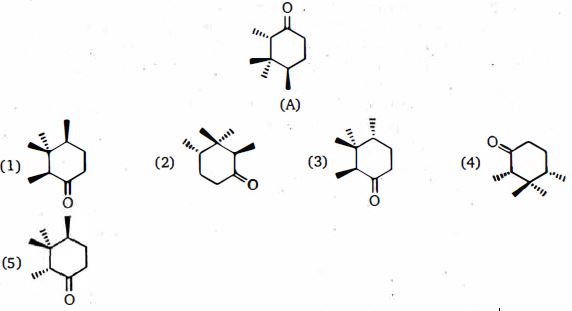
$\begin{matrix}
   \,\,\,\,\,O\,\,\,\,\,\,\,\,\,\,\,\,\,\,\,\,\,\,\,\,\,\,\,\,C{{H}_{3}}  \\
   ||\,\,\,\,\,\,\,\,\,\,\,\,\,\,\,\,\,\,\,\,\,\,\,\,\,\,\,\,|\,  \\
   C{{H}_{3}}-C-C{{H}_{2}}-C-CHO  \\
   \,\,\,\,\,\,\,\,\,\,\,\,\,\,\,\,\,\,\,\,\,\,\,\,\,\,\,\,\,\,\,|  \\
   \,\,\,\,\,\,\,\,\,\,\,\,\,\,\,\,\,\,\,\,\,\,\,\,\,\,\,\,\,\,\,\,\,\,\,\,C{{H}_{3}}  \\
\end{matrix}\xrightarrow{KOH,{{H}_{2}}O}(A);$ Product $A$ is
Which of the structures is/are diastereomer of $A$ ?
The vapour pressure of pure benzene and methyl benzene at $27^{\circ} \mathrm{C}$ is given as $80 \mathrm{Torr}$ and $24 \mathrm{Torr}$, respectively. The mole fraction of methyl benzene in vapour phase, in equilibrium with an equimolar mixture of those two liquids (ideal solution) at the same temperature is. . . . . . .$\times 10^{-2}$ (nearest integer)