Question
How many pairs of adjacent angles are formed when two lines intersect in a point?
Answer

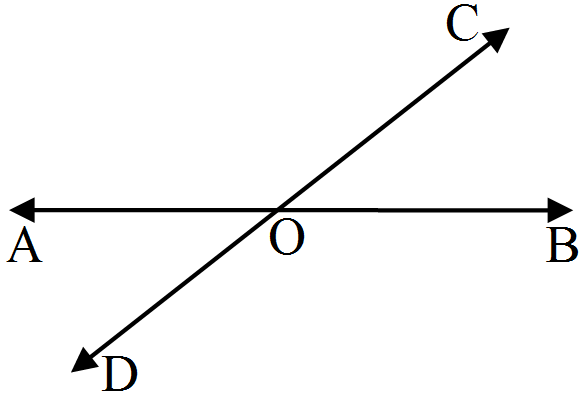
Let us draw the following diagram showing two lines $AB$ and $CD$ intersecting at a point $O$.

We have the following pair of adjacent angles,
so formed: $\angle\text{AOC}$ and $\angle\text{BOC}$
$\angle\text{AOC}$ and $\angle\text{AOD}$
$\angle\text{BOD}$ and $\angle\text{BOC}$
$\angle\text{BOD}$ and $\angle\text{AOD}$
Hence, in total four pair of adjacent angles are formed.

Need a full question paper?

Generate a complete, print-ready paper with questions like this in minutes — across 16+ boards, with answer keys.

Start Generating Free

Similar questions

The following is the distribution of total household expenditure (in ₹) of manual worker in a city:
Expenditure (in ₹): $100-150$ $150-200$ $200-250$ $250-300$ $300-350$ $350-400$ $400-450$ $450-500$
No. of manual workers: $25$ $40$ $33$ $28$ $30$ $22$ $16$ $8$
Draw a histogram and a frequency polygon representing the above data.
$ABCD$ is a parallelogram in which $\angle\text{A}=70^\circ$ Compute $\angle\text{B},\angle\text{C}$ and $\angle\text{D}$.
(Street Plan): A city has two main roads which cross each other at the centre of the city. These two roads are along the North-South direction and East-West direction. All the other streets of the city run parallel to these roads and are $200 \ m$ apart. There are $5$ streets in each direction. Using $1\ cm = 200 \ m$, draw a model of the city on your notebook. Represent the roads/streets by single lines. There are many cross- streets in your model. A particular cross-street is made by two streets, one running in the North-South direction and another in the East-West direction. Cross street is referred to in this manner: If the 2nd street running in the North-South direction and 5th in the East-West direction meet at some crossing, then we will call this cross-street $(2, 5)$. Using this convention, find: how many cross - streets can be referred to as $(3, 4).$
Look at several examples of rational numbers in the form $\frac{p}{q}(q \neq 0)$, where $p$ and $q$ are integers with no common factors other than $1$ and having terminating decimal representations (expansions). Can you guess what property $q$ must satisfy?
Verify whether the indicated numbers are zeros of the polynomials corresponding to them in the following case: $\text{g(x)}=3\text{x}^2-2,\text{x}=\frac{2}{\sqrt{3}},\frac{-2}{\sqrt{3}}$
Find the value of the polynomial $3 x^3-4 x^2+7 x+5$, when $x =3$ and also when $x =-3$.
If $x=1$ and $y=6$ is a solution of the equation $8 x-a y+a^2=0$, find the values of $a$.
Find the value k if $x - 3$ is a factor of $k^2x^3 - kx^2 + 3kx - k.$
Simplify:
$\frac{1.2\times1.2\times1.2-0.2\times0.2\times0.2}{1.2\times1.2+1.2\times0.2+0.2\times0.2}$
Three equal cubes are placed adjacently in a row. Find the ratio of a total surface area of the new cuboid to that of the sum of the surface areas of the three cubes.