Question
How many spherical lead shots each of diameter 4.2cm can be obtained from a solid rectangular lead piece with dimensions 66cm × 42cm × 21cm.

Answer

Given that, lots of spherical lead of shots made from a solid rectangular lead piece.
$\therefore$ Number of spherical lead shots
$=\frac{\text{volume of solid rectangular lead piece}}{\text{volume of a spherical lead shot}}\ ...(\text{i})$
Also, given that diameter of a spherical lead shot i.e. sphere = 4.2cm
$\therefore$ Radius of a spherical lead shot,
$\text{r}=\frac{4.2}{2}=2.1\text{cm}[\therefore\text{radius}=\frac{1}{2}\text{diameter}]$
So, volume of a spherical lead shot i.e.
$\text{sphere}=\frac{4}{3}\pi\text{r}^3$
$=\frac{4}{3}\times\frac{22}{7}\times(2.1)^3$
$=\frac{4}{3}\times\frac{22}{7}\times2.1\times2.1\times2.1$
$=\frac{4\times22\times21\times21\times21}{3\times7\times1000}$
Now, length of rectangular lead piece, l = 66cm
Breadth of rectangular lead piece, b = 42cm
Hieght of rectangular lead piece, h = 21cm
$\therefore$ Volume of a solid rectangular lead piece i.e.
cuboid = l × b × h = 66 × 42 × 21
From Eq. (i), Number of spherical lead, shots
$\frac{66\times42\times21}{4\times22\times21\times21\times21}\times3\times7\times1000$
$=\frac{3\times22\times21\times2\times21\times21\times1000}{4\times22\times21\times21\times21}$
$=3\times2\times250$
$=6\times250=1500$
Hence, the required number of spherical lead shots is 1500.

Need a full question paper?

Generate a complete, print-ready paper with questions like this in minutes — across 16+ boards, with answer keys.
Start Generating Free

Similar questions

The sum of a two-digit number and the number formed by reversing the order of digit is 66. If the two digits differ by 2, find the number. How many such numbers are there?
Draw a line segment AB of length 7cm. Using ruler and compasses, find a point P on AB such that $\frac{\text{AP}}{\text{AB}}=\frac{3}{5}.$
Solve the following equations by using the method of completing the square:
$2x^2 + 5x - 3 = 0$
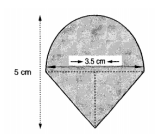
Rasheed got a playing top $($lattu$)$ as his birthday present, which surprisingly had no colour on it. He wanted to colour it with his crayons. The top is shaped like a cone surmounted by a hemisphere. The entire top is $5 \ cm$ in height and the diameter of the top is $3.5 \ cm$ . Find the area he has to colour. $($Take $\pi=\frac{22}{7} )$.
Image
Solve the following quadratic equations by factorization:
$3\Big(\frac{7\text{x}+1}{5\text{x}-3}\Big)-4\Big(\frac{5\text{x}-3}{7\text{x}+1}\Big)=11,$ $\text{x}\neq\frac{3}{5},-\frac{1}{7}$
Solve the following system of equations by the method of cross-multiplication:
$\frac{5}{\text{x}+\text{y}}-\frac{2}{\text{x}-\text{y}}=-1,$
$\frac{15}{\text{x}+\text{y}}+\frac{7}{\text{x}-\text{y}}=-10,$ where $\text{x}\neq0$ and $\text{y}\neq0.$
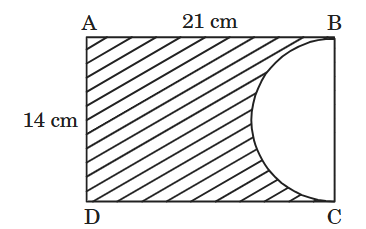
In the given figure, ABCD is a rectangle of dimensions $21 cm \times 14 cm$. A semicircle is drawn with BC as diameter. Find the area and the perimeter of the shaded region in the figure.
Image
A man saved Rs. 32 during the first year, Rs. 36 in the second year and in this way he increases his saving by Rs. 4 every year. Find in what time his saving will be Rs. 200.
A reservoir in the form of the frustum of a right circular cone contains $44 \times 10^7$ litres of water which fills it completely. The radii of the bottom and top of the reservoir are 50 metres and 100 metres respectively. Find the depth of water and the lateral surface area of the reservoir.
Prove the following identities:
$\Bigg\{\frac{1}{\big(\sec^2\theta-\cos^2\theta\big)}+\frac{1}{\big(\text{cosec}^2\theta-\sin^2\theta\big)}\Bigg\}\big(\sin^2\theta\cos^2\theta\big)$
$=\frac{1-\sin^2\theta\cos^2\theta}{2+\sin^2\theta\cos^2\theta}$