Question
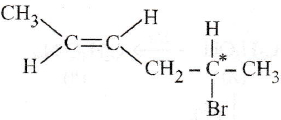
How many stereoisomers does this molecule have ?

$CH_3CH=CHCH_2CHBrCH_3$

Answer

c
$C^{*}=$ asymmetric carbon

Number of optical isomers $=2^{n}$

where, $n=$ number of asymmetric carbon atoms

$2^{1}=2$

Number of geometrical isomers $=2^{n}$ where, $n=$ number of double bonds $=2^{1}=2$

Hence, total number of stereoisomers $=$ Total optical isomers $4\,-$ Total geometrical isomers

$=2+2=4$
Need a full question paper?

Generate a complete, print-ready paper with questions like this in minutes — across 16+ boards, with answer keys.

Start Generating Free

Similar questions

The activation energy for a reaction is $9.0\,K\,cal/mol.$ The increase in the rate constant when its temperature is increased from $298\,K$ to $308\,K$ is ......... $\%$
$20\,g$ of hydrogen is present in $5\,litre$ vessel. The molar concentration of hydrogen is
Among the given oxides of nitrogen; $N _{2} O , N _{2} O _{3}$, $N _{2} O _{4}$ and $N _{2} O _{5}$, the number of compound/(s) having $N - N$ bond is ...
The number of ionisable hydrogens present in the product obtained from a reaction of phosphorus trichloride and phosphonic acid is
Hydrolysis of $DDT$  is a first order reaction, its half life is $ 10 $ years. Time to hydrolyse $10$ $g$ $ DDT$  to half is ......... $years$
If the concentration of glucose $\left(\mathrm{C}_{6} \mathrm{H}_{12} \mathrm{O}_{6}\right)$ in blood is $0.72\, \mathrm{~g} \,\mathrm{~L}^{-1}$, the molarity of glucose in blood is $.....\,\times 10^{-3} \mathrm{M}$. (Nearest integer)

(Given: Atomic mass of $\mathrm{C}=12, \mathrm{H}=1, \mathrm{O}=16 \mathrm{u}$ )

The oxidation number of $Cr$  in $[Cr{(N{H_3})_6}]C{l_3}$ is
Consider the following equations:

$2 Fe ^{2+}+ H _{2} O _{2} \rightarrow x A + y B$

(in basic medium)

$2 MnO _{4}^{-}+6 H ^{+}+5 H _{2} O _{2} \rightarrow x ^{\prime} C + y ^{\prime} D + z ^{\prime} E$

(in acidic medium)

The sum of the stoichiometric coefficients $x , y , x ^{\prime}, y ^{\prime}$ and $z ^{\prime}$ for products $A , B , C , D$ and $E ,$ respectively, is............
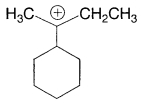
The total number of contributing structures showing hyperconjugation (involving $C - H$ bonds) for the following carbocation is
At $25\,^oC$, the vapour pressure of pure liquid $A$ ($mol\,. wt. = 40$) is $100\, torr$, while that of pure liquid $B$ is $40\, torr$, $(mol\,. wt. = 80)$. The vapour pressure at $25\,^oC$ of a solution containing $20\, g$ of each $A$ and $B$ is .......... $torr$.