Question
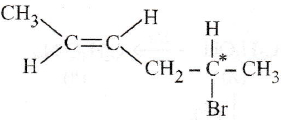
How many stereoisomers does this molecule have ?

$CH_3CH=CHCH_2CHBrCH_3$

Answer

c
$C^{*}=$ asymmetric carbon

Number of optical isomers $=2^{n}$

where, $n=$ number of asymmetric carbon atoms

$2^{1}=2$

Number of geometrical isomers $=2^{n}$ where, $n=$ number of double bonds $=2^{1}=2$

Hence, total number of stereoisomers $=$ Total optical isomers $4\,-$ Total geometrical isomers

$=2+2=4$
Need a full question paper?

Generate a complete, print-ready paper with questions like this in minutes — across 16+ boards, with answer keys.

Start Generating Free

Similar questions

The number of waves made by any electron moving in an orbit having maximum magnetic quantum number $\left( {{m_l}} \right) + 3$ is
$p-$ Toluedine reacts with benzene diazonium chloride to form compound, which  on boiling with $aq. H_2 SO_4$ give ........ . products
Dissolving $120\, g$ of a compound (mol. wt. $60$) in $1000\, g$ of water gave a solution of density $1.12\, g/mL$. The molarity of the solution is ............ $\mathrm{M}$
$29.2 \%(w / w) HCl ^2$ stock solution has a density of $1.25 \ g mL ^{-1}$. The molecular weight of $HCl$ is $36.5 \ g mol ^{-1}$. The volume $( mL )$ of stock solution required to prepare a $200 \ mL$ solution of $0.4 \ M HCl$ is :
On complete reaction of $FeCl _{3}$ with oxalic acid in aqueous solution containing $KOH$, resulted in the formation of product $A$. The secondary valency of $Fe$ in the product $A$ is ...... .
(Round off to the Nearest Integer).
Consider the data given below for hypothetical reaction $A \to X$

$Time  (sec)$                     Rate $(mol\,  L^{-1} sec.^{-1})$

$0$                                      $1.60 \times 10^{-2}$

$10$                                    $1.60 \times 10^{-2}$

$20$                                    $1.60 \times 10^{-2}$

$30$                                    $1.60 \times 10^{-2}$

From the above data, the order of reaction is
Image
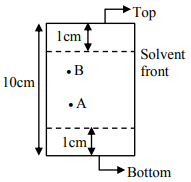
"In the given $\text{TLC},$ the distance of spot $A \ B$ are $5 \ cm \ 7 \ cm,$ from the bottom of $\text{TLC}$ plate, respectively. $R _f$ value of $B$ is $x \times 10^{-1}$ times more than $A$ . The value of $x$ is $............$
The rate constant of a reaction increases by five times on increase in temperature from $27^{\circ} C$ to $52^{\circ} C$. The value of activation energy in $kJ mol ^{-1}$ is $.... .$ (Rounded-off to the nearest integer) $\left[ R =8.314\, J \,K ^{-1} \,mol ^{-1}\right]$
When $10 \mathrm{~mL}$ of an aqueous solution of $\mathrm{Fe}^{2+}$ ions was titrated in the presence of dil $\mathrm{H}_{2} \mathrm{SO}_{4}$ using diphenylamine indicator, $15 \mathrm{~mL}$ of $0.02 \mathrm{M}$ solution of $\mathrm{K}_{2} \mathrm{Cr}_{2} \mathrm{O}_{7}$ was required to get the end point. The molarity of the solution containing $\mathrm{Fe}^{2+}$ ions is $\mathrm{X} \times 10^{-2} \mathrm{M}$. The value of $\mathrm{x}$ is $....$ (Nearest integer)
Consider the cell

$Pt ( s )\left| H _2( s )( latm )\right| H ^{+}\left( aq ,\left[ H ^{+}\right]=1\right)|| Fe ^{3+}( aq ), Fe ^{2+}( aq ) \mid \operatorname{Pt}( s )$

Given : $E _{ Fe ^{3+} / e ^{2 *}}^0=0.771\,V$ and $E _{ H ^{+}+\frac{1}{2} H _2}^0=0 V , T =298\,K$

If the potential of the cell is $0.712\,V$ the ratio of concentration of $Fe ^{2+}$ to $Fe ^{2+}$ is $........$.(Nearest integer)