MCQ
How many structural isomers are possible for a compound with molecular formula ${C_3}{H_7}Cl$
  • 2
  • B
    5
  • C
    7
  • D
    9

Answer

Correct option: A.
2
a
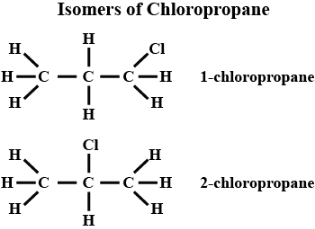
The compound having the molecular formula $C _3 H _7 Cl$ will have two different structural isomers which are $1-$chloropropane and $2-$chloropropane. Their structure is shown in the figure.

Need a full question paper?

Generate a complete, print-ready paper with questions like this in minutes — across 16+ boards, with answer keys.

Start Generating Free

Similar questions

Which of the following is incorrectly matched?

Complex        $-$        Number of unpaired electrons

Three moles of $B _2 H _6$ are completely reacted with methanol. The number of moles of boron containing product formed is
Solubility of $AgCl$ in conc. $HCl$ is ...... than in water.
Given below are two statements: one is labelled as Assertion $(A)$ and the other is labelled as Reason $(R)$. Assertion $(A)$ : In aqueous solutions $\mathrm{Cr}^{2+}$ is reducing while $\mathrm{Mn}^{3+}$ is oxidising in nature.

Reason $(R)$ : Extra stability to half filled electronic configuration is observed than incompletely filled electronic configuration.

In the light of the above statement, choose the most appropriate answer from the options given below:

The difference in the oxidation state of $Xe$ between the oxidised product of $Xe$ formed on complete hydrolysis of $XeF _4$ and $XeF _4$ is
At ${25\,^o}C$, the highest osmotic pressure is exhibited by $0.1\,M$ solution of
Which electron is associated with the least energy
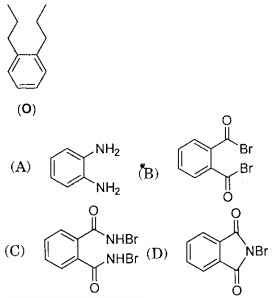
Treatment of compound $O$ with $KMnO_4 / \mathrm{H}^{+}$gave $P$, which on heating with ammonia gave $Q$. The compound $Q$ on treatment with $Br_2 / NaOH$ produced $R$. On strong heating, $Q$ gave $S$, which on further treatment with ethyl $2$-bromopropanoate in the presence of $KOH$ followed by acidification, gave a compound $T$.

(image)

($1$) The compound $R$ is

(image)

($2$) The compound $T$ is

($A$) glycine

($B$) alanine

($C$) valine

($D$) serine

Given the answer question ($1$) and ($2$) 
$XeF_2$ reacts with $SbF_5$ to form
Which of the following is structure of a separating finnel?