Question
How many vertebrae in all do we have? Categorise them on the basis of their location giving the specific number in each category.

Answer

There are 26 (twenty-six) vertebrae in total in our body. On the basis of location, they are the following:
i. Cervical vertebrae: Found in neck region; 7 in number.
ii. Thoracic vertebrae: Found in thoracic region; 12 in number.
iii. Lumbar vertebrae: Present in abdominal region; 5 in number.
iv. Sacrum: In the lowermost region of the vertebral column; 2 fused bones.
v. Coccyx: Lies Oat end of the vertebral column; vestigial tail bone.

Need a full question paper?

Generate a complete, print-ready paper with questions like this in minutes — across 16+ boards, with answer keys.
Start Generating Free

Similar questions

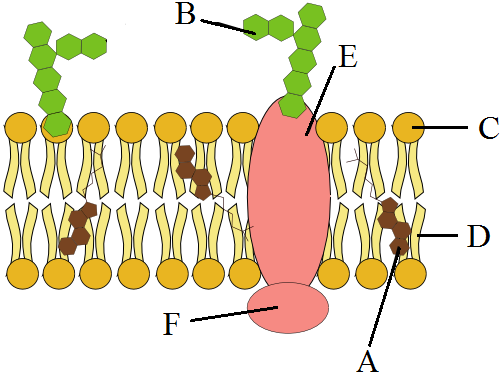
The diagram shows a section of cell membrane. Identify the components labelled A-F.
Ria went to see the zoo in her town with her parents and saw many wild animals, their food habits, behaviour, etc. She saw that there was a wide variety of animal life in the zoo. But she was amazed to see that the board placed in front of lion cage and monkey place which tells that both were mammals. However, she thought that they were totally different in appearance.
  1. Why lions and monkeys are considered to be mammals?
  2. Explain the scientific reason to maintain a zoological park.
  3. Is there any similar place to see a variety of plants? If any, then name some.
  4. What values are shown by Ria?
Write two names for each of the following:
  1. Free-living, nitrogen-fixing cyanobacteria.
  2. Free-living, aerobic, nitrogen-fixing bacteria.
  3. Symbiotic, nitrogen-fixing bacteria.
Differentiate between an Insect and Spider.
What is lymph? Write down four differences between $T$ cells and $B$ cells.
Name the categories of plant hormones concerned with each of the following and describe one other function of each of the three categories of plant hormones.
  1. Inhibition of seed germination.
  2. Promote flowering.
  3. Cell division promoting activity.
Give a brief account of viruses with respect to their structure and nature of genetic material. Also name four common viral diseases.
Mention the similarities between the:
  1. Cardiac and skeletal muscles.
  2. Cardiac and smooth muscles.
What is an electrocardiogram? What do P wave and QRS complex represent in a standard ECG?
Write the functions of epidermal tissue system.