Question
How much is $x^2-2 x y+3 y^2$ less than $2 x^2-3 y^2+x y$ ?

Answer

Required expression:
$=\left(2 x^2-3 y^2+x y\right)-\left(x^2-2 x y+3 y^2\right)$
$=2 x^2-3 y^2+x y-x^2+2 x y-3 y^2$
Collecting positive and negative like terms together, we get
$2 x^2-x^2-3 y^2-3 y^2+x y+2 x y$
$=x^2-6 y^2+3 x y$

Need a full question paper?

Generate a complete, print-ready paper with questions like this in minutes — across 16+ boards, with answer keys.

Start Generating Free

Similar questions

Find the product $-3 y\left(x y+y^2\right)$ and evaluate it fore $x=4$ and $y=5$.
Reema took a loan of $Rs. 8000$ from a money lender, who charged interest at the rate of $18\%$ per annum. After $2$ years, Reema paid him $Rs. 10400$ and wristwatch to clear the debt. What is the price of the watch?
In the following, find of equivalent form of the rational number having a common denominator:
$\frac{2}{3}, \frac{7}{6}$ and $\frac{11}{12}$
Find the quotient by converting the denominator into 1, 10, 100, or 1000 and verify the solution by the long division method (division by place value):
$\frac{415}{4}$
The temperature variation over two days in different months in Jodhpur, Rajasthan, is given below. Draw a double-bar graph. Use the scale 1 unit = 4°C. Can you guess which two months these days might belong to?
12 am3 am6 am9 am12 pm3 pm6 pm9 pm
Day 120°C18°C16°C20°C26°C34°C30°C24°C
Day 237°C34°C30°C33°C37°C43°C42°C39°C
Mohit sold a watch to Karim at a gain of $10\%$ and Karim sold it to Rahim at a gain of $4\%.$ If Rahim pays $Rs. 14300$ for it, for how much did Mohit purchase it$?$
Add and express the sum as a mixed fraction: $\frac{-12}{5}+\frac{43}{10}$
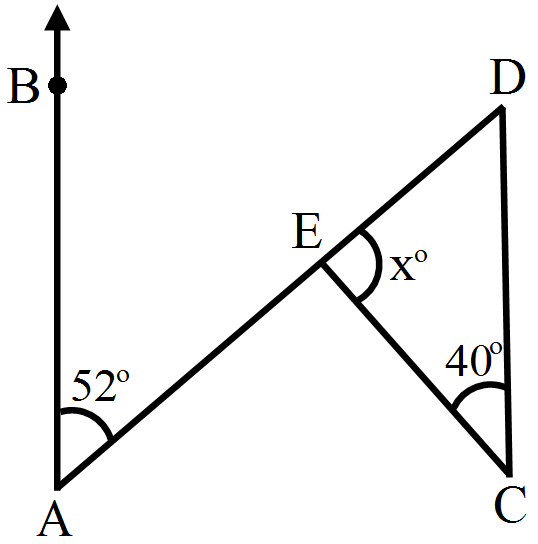
Compute the value of $x$ in the following figure.
Draw, wherever possible, a rough sketch of
(i) a triangle with both line and rotational symmetries of order more than 1.
(ii) a triangle with only line symmetry and no rotational symmetry of order more than 1.
(iii) a quadrilateral with a rotational symmetry of order more than 1, but not a line symmetry.
(iv) a quadrilateral with line symmetry, but not a rotational symmetry of order more than 1.