MCQ
How much work does a pulling force of $40 \,N$ do on the $20\, kg$ box in pulling it $8 \,m $ across the floor at a constant speed. The pulling force is directed at $60^o $ above the horizontal.....$J$
  • $160 $
  • B
    $277$
  • C
    $784 $
  • D
    None of the above

Answer

Correct option: A.
$160 $
a
(a) $W = \vec F.\vec s = 40 \times 8 \times \cos 60^\circ = 160\,J$

Need a full question paper?

Generate a complete, print-ready paper with questions like this in minutes — across 16+ boards, with answer keys.

Start Generating Free

Similar questions

A projectile fired at $30^{\circ}$ to the ground is observed to be at same height at time $3 s$ and $5 s$ after projection, during its flight. The speed of projection of the projectile is $.........\,ms ^{-1}$(Given $g=10\,m s ^{-2}$ )
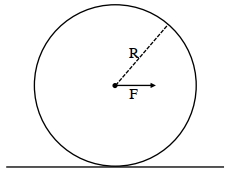
A horizontal force $F$ is applied at the center of mass of a cylindrical object of mass $m$ and radius $R$, perpendicular to its axis as shown in the figure. The coefficient of friction between the object and the ground is $\mu$. The center of mass of the object has an acceleration $a$. The acceleration due to gravity is $g$. Given that the object rolls without slipping, which of the following statement($s$) is(are) correct?

$(A)$ For the same $F$, the value of $a$ does not depend on whether the cylinder is solid or hollow

$(B)$ For a solid cylinder, the maximum possible value of $a$ is $2 \mu g$

$(C)$ The magnitude of the frictional force on the object due to the ground is always $\mu m g$

$(D)$ For a thin-walled hollow cylinder, $a=\frac{F}{2 m}$

The rms speed of oxygen at room temperature is about 500m/ s. The rms speed of hydrogen at the same temperature is about:
  1. 125ms-1
  2. 2000ms-1
  3. 8000ms-1
  4. 31ms-1
The potential difference applied to an X-ray tube is increased. As a result, in the emitted radiation:
  1. The intensity increases.
  2. The minimum wavelength increases.
  3. The intensity remains unchanged.
  4. The minimum wavelength decreases.
There are two points $P$ and $Q$ on a projectile with velocities $v_P$ and $v_Q$ respectively such that $v_P$ is perpendicular to $v_Q$ and $\alpha$ is the angle that $v_P$ makes with horizontal at point $P$. Find the correct option
The mass of a planet is $\frac{1}{10}^{\text {th }}$ that of the earth and its diameter is half that of the earth. The acceleration due to gravity on that planet is:
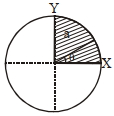
The disc of mass $M$ with uniform surface mass density $\sigma$ is shown in the figure. The centre of mass of the quarter disc (the shaded area) is at the position $\frac{x}{3} \frac{a}{\pi}, \frac{x}{3} \frac{a}{\pi}$ where $x$ is ....... .

(Round off to the Nearest Integer) $[ a$ is an area as shown in the figure $]$

The angular velocities of three bodies in simple harmonic motion are ${\omega _1},\,{\omega _2},\,{\omega _3}$ with their respective amplitudes as ${A_1},\,{A_2},\,{A_3}$. If all the three bodies have same mass and velocity, then
A string of negligible thickness is wrapped several times around a cylinder kept on a rough horizontal surface. A man standing at a distance 1 from the cylinder holds one end of the string and pulls the cylinder towards him. There is no slipping anywhere. The length of the string passed through the hand of the man while the cylinder reaches his hands is:
An observer moves with a constant speed along the line joining two stationary objects. He will observe that the two objects