Question
How were simple organic molecules formed on the earth?

Answer

1. Initially earth’s temperature was very high but as the cooling process started, lighter elements reacted chemically with each other.
2. The early atmosphere was rich in hydrogen, carbon, nitrogen and sulphur. Hydrogen was most active and hence it reacted with other elements to form chemicals on earth like CH4, NH3, H20 and H2S.
3. With decreasing temperature of the earth, steam condensed into water that resulted in heavy rainfall. This constantiy falling rainwater got accumulated on the land to form different water bodies and especially oceans. It also cooled down the earth.
4. The early molecules of hydrocarbons, ammonia, methane and water underwent reactions like condensation, polymerisation, oxidation and reduction due to different energy sources such as ultra-violet rays, radiations, lightning and volcanic activities.
5. These reactions resulted in formation of simple organic molecules like monosaccharides, amino acids, purines, pyrimidines, fatty acids, glycerol, etc.

Need a full question paper?

Generate a complete, print-ready paper with questions like this in minutes — across 16+ boards, with answer keys.
Start Generating Free

Similar questions

Deaddiction may be difficult but not impossible. Collect information about NGOs, working in the field of deaddiction.

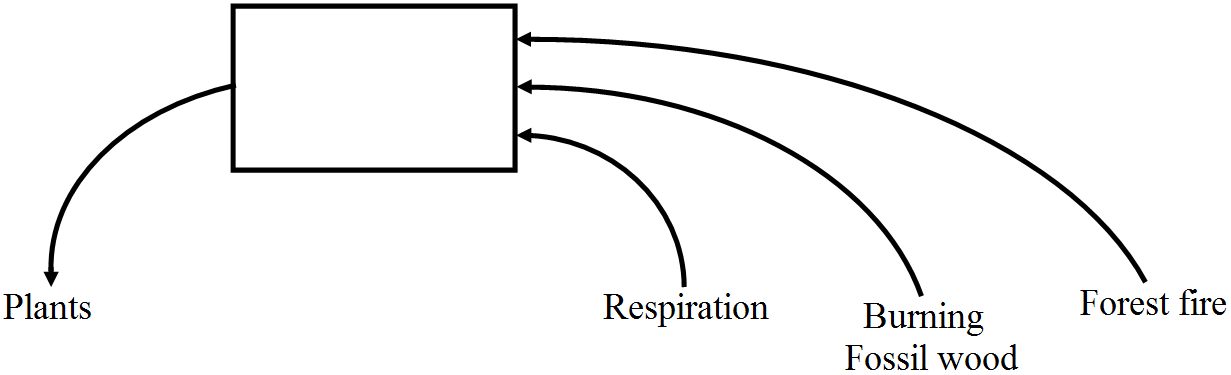
The above diagram shows a simplified biogeochemical cycle.
  1. Name the compound whose cycle is depicted.
  2. In what way do vehicles add this compound to atmosphere?
  3. What adverse effect does its excess have on the environment?
  4. Cite an event which depicts this effect in the modern times.
  5. Suggest two ways of reducing this effect.
  1. With labelled diagrams, depict the stages in embryo development in a dicotyledonous plant.
  2. Endosperm development precedes embryo development. Why?
What is meant by R cells and S cells with which Frederick Griffith carried out this experiments on Streptococcus pneumoniae? What did he prove from these experiments?
Discuss about discovery of Gibberellins.
Describe in brief an account of disorders of the thyroid.
OR
What are the functional disorders of thyroid gland? Describe in brief.
Secretions of adrenal medulla and their role.
‘There is a paternity dispute for a child’. Which technique can solve the problem. Discuss the principle involved.
  1. Explain with the help of Griffith’s experiment how the search for genetic material was conducted and what was the conclusion drawn?
  2. How did MacLeod, McCarty and Avery establish the biochemical nature of the so called ‘genetic material’ identified by Griffith in his experiment.
How are genetic disorders broadly classified? Differentiate between them. Explain by giving one example for each.