MCQ
How will two parallel beams of electron behave while moving in the same direction?
- ARepel each other
- BAttract each other
- CNot interact with each other
- DAnnihilate each other
Explanation:
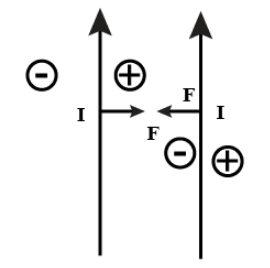
Two parallel beams of electron moving in the same direction can be think of like two current carrying wire in same direction.
The situation is shown in the figure. The direction indicated shows that wire 2 will be attracted towards wire 1. In a similar manner, one can show that wire 1 will experience a force due to the magnetic field of wire 2, and that this force will have a magnitude equal to that of F2 but opposite in direction. Thus, wire 1 will be attracted towards wire 2.
Generate a complete, print-ready paper with questions like this in minutes — across 16+ boards, with answer keys.
Two long wires are hanging freely. They are joined first in parallel and then in series and then are connected with a battery. In both cases, which type of force acts between the two wires
|
(a) Attraction force when in parallel and repulsion force when in series |
|
(b) Repulsion force when in parallel and attraction force when in series |
|
(c) Repulsion force in both cases |
|
(d) Attraction force in both cases |
Two tangent galvanometers having coils of the same radius are connected in series. A current flowing in them produces deflections of 60° and 45° respectively. The ratio of the number of turns in the coils is
| (a) 4/3 |
(b) (
|
(c) (
|
(d) 
|
Electrons with energy 80 keV are incident on the tungsten target of an X-ray tube. K shell electrons of tungsten have ionization energy 72.5 keV. X-rays emitted by the tube contain only
|
(a) A continuous X-ray spectrum (Bremsstrahlung) with a minimum wavelength of ~ 0.155Å |
|
(b) A continuous X-ray spectrum (Bremsstrahlung] with all wavelengths |
|
(c) The characteristic X-rays spectrum of tungsten |
|
(d) A continuous X-ray spectrum (Bremsstrahlung) with a minimum wavelength of ~ 0.155Å and the characteristic X-ray spectrum of tungsten |
Two thin lenses, one of focal length + 60 cm and the other of focal length – 20 cm are put in contact. The combined focal length is
|
(a) + 15 cm |
(b) – 15 cm |
(c) + 30 cm |
(d) –30 cm |
A uniform wire is bent in the form of a circle of radius R. A current I enters at A and leaves at C as shown in the figure :
If the length ABC is half of the length ADC, the magnetic field at the centre O will be

|
(a) Zero |
(b) |
(c) |
(d) |


