MCQ
How will two parallel beams of electron behave while moving in the same direction?
- ARepel each other
- BAttract each other
- CNot interact with each other
- DAnnihilate each other
Explanation:
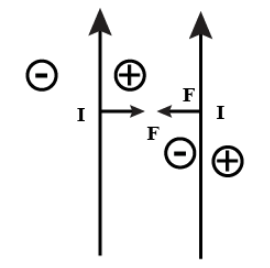
Two parallel beams of electron moving in the same direction can be think of like two current carrying wire in same direction.
The situation is shown in the figure. The direction indicated shows that wire 2 will be attracted towards wire 1. In a similar manner, one can show that wire 1 will experience a force due to the magnetic field of wire 2, and that this force will have a magnitude equal to that of F2 but opposite in direction. Thus, wire 1 will be attracted towards wire 2.
Generate a complete, print-ready paper with questions like this in minutes — across 16+ boards, with answer keys.
Basically, the product modulator is
|
(a) An amplifier |
(b) A mixer |
|
(c) A frequency separator |
(d) A phase separator |
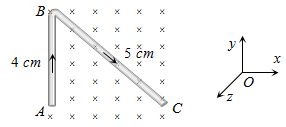
A uniform conducting wire ABC has a mass of 10g. A current of 2A flows through it. The wire is kept in a uniform magnetic field B = 2T. The acceleration of the wire will be
| (a) Zero |
(b) 12  along y-axis along y-axis
|
(c) 1.2  along y-axis along y-axis
|
(d) 0.6 along y - axis
|
The ionisation energy of 10 times ionised sodium atom is
|
(a) 13.6 eV |
(b) 13.6 × 11 eV |
(c) |
(d) 13.6 × (11)2 eV |
If the refractive indices of crown glass for red, yellow and violet colours are 1.5140, 1.5170 and 1.5318 respectively and for flint glass these are 1.6434, 1.6499 and 1.6852 respectively, then the dispersive powers for crown and flint glass are respectively
|
(a) 0.034 and 0.064 |
(b) 0.064 and 0.034 |
(c) 1.00 and 0.064 |
(d) 0.034 and 1.0 |
