Question
How will you bring about the following conversions?
Methyl bromide to acetone.

Answer

$\text{CH}_3-\text{Br}\xrightarrow{\text{CH}\equiv\text{C}^-\text{Na}^+}\text{CH}_3-\text{C}\equiv\text{CH}\\_\text{Methyl bromide}$$\ \ \ \ \ \ \ \ \ \ \ \ \ \ \ \ \ \ \ \ \ \ \ \ \ \text{O}\\ \ \ \ \ \ \ \ \ \ \ \ \ \ \ \ \ \ \ \ \ \ \ \ \ \ ||\\\xrightarrow[\text{HgSO}_4]{\text{H}_2\text{SO}_4}\text{CH}_3-\text{C}-\text{CH}_3\\\ \ \ \ \ \ \ \ \ \ \ \ \ \ \ \ \ \ \ \ \ \ _\text{Acetone}$

Need a full question paper?

Generate a complete, print-ready paper with questions like this in minutes — across 16+ boards, with answer keys.
Start Generating Free

Similar questions

Calculate the temperature at which a solution containing $54 g$ of glucose$, \ce{C6H12O6},$ in $250 g$ of water will freeze. $[K_f$ for water $= 1.86 K \ kg\ mol^{–1}]$.
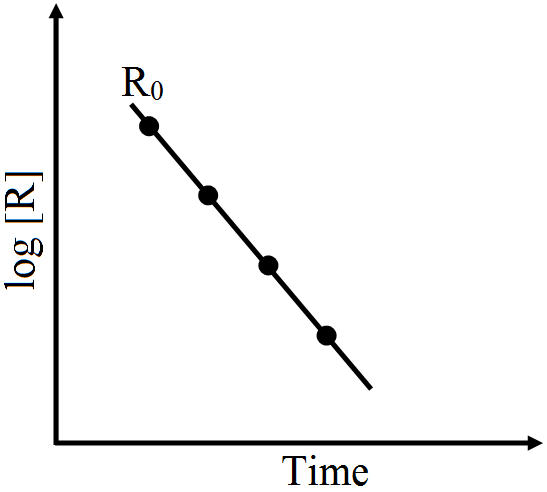
Observe the graph in diagram and answer the following questions.
  1. If slope is equal to $-2.0 \times 10^{-6} \sec^{-1} ,$ what will be the value of rate constant?
  2. How does the half$-$life of zero order reaction relate to its rate constant?
From the following molar conductivities at infinite dilution, calculate $\Lambda^0_{\text{m}}$ for $\ce{NH_4OH}.$
$\Lambda^0_{\text{m}}\text{ for }\text{Ba(OH)}_2=457.6\Omega^{-1}\text{cm}^2\text{mol}^{-1}$
$\Lambda^0_{\text{m}}\text{ for }\text{BaCl}_2=240.\Omega^{-1}\text{cm}^2\text{mol}^{-1}$
$\Lambda^{0}_{\text{m}}\text{ for }\text{NH}_4\text{Cl}=129.8\Omega^{-1}\text{cm}^2\text{mol}^{-1}$
Calculate the emf of the following cell at $25^{\circ} C$.$Fe \left| Fe ^{2+}(0.001 M )\right|\left| H ^{+}(0.01 M )\right| H _2(g)(1 bar ) \mid Pt ( s )$
Given that, $E_{ Fe ^{2+} / Fe }^o=-0.44 V ; E_{H^{+} / H_2}^o=0.00 V$
A violet compound of manganese $(A)$ decomposes on heating to liberate oxygen and compounds $(B)$ and $(C)$ of manganese are formed. Compound $(C)$ reacts with $\text{KOH}$ in the presence of potassium nitrate to give compound $(B)$. On heating compound $(C)$ with conc. $\ce{H_2SO_4}$ and $\ce{NaCl},$ chlorine gas is liberated and a compound $(D)$ of manganese along with other products is formed. Identify compounds $A$ to $D$ and also explain the reactions involved.
A first order reaction is 50% completed in 40 minutes at 300 K and in 20 minute at 320 K. Calculate the activation energy of the reaction. (Given: log 2=0.3010, log 4=0.6021, $R=8.314$ $J~K^{-1}$ mol).
Give reasons for the following:
  1. Transition elements and their compounds act as catalysts.
  2. $E^0$ value for $\ce{(Mn^{2+}|Mn)}$ is negative whereas for $\ce{(Cu^{2+}|Cu)}$ is positive.
  3. Actinoids show irregularities in their electronic configuration.
Write one chemical equation for each, to illustrate the following reactions:
  1. Rosenmund reduction.
  2. Cannizzaro reaction.
  3. Fischer esterification.
  1. Explain the following giving suitable examples:
  1. Sandmeyer’s reaction.
  2. Coupling reaction of a diazonium salt.
  1. Explain the observed $K_b$ order:
$\ce{Et_2NH > Et_3N > EtNH_2}$ in aqueous solution.
Match the items of column $I$ with items of column $II$.
 
Column $I$
 
Column $II$
$(i)$
Antifreeze used in car engine
$(a)$
Neutral ferric chloride
$(ii)$
Solvent used in perfumes
$(b)$
Glycerol
$(iii)$
Starting material for picric acid
$(c)$
Methanol
$(iv)$
Wood spirit
$(d)$
Phenol
$(v)$
Reagent used for detection of phenolic group
$(e)$
Ethleneglycol
$(vi)$
By product of soap industry used in cosmetics
$(f)$
Ethanol.