Question
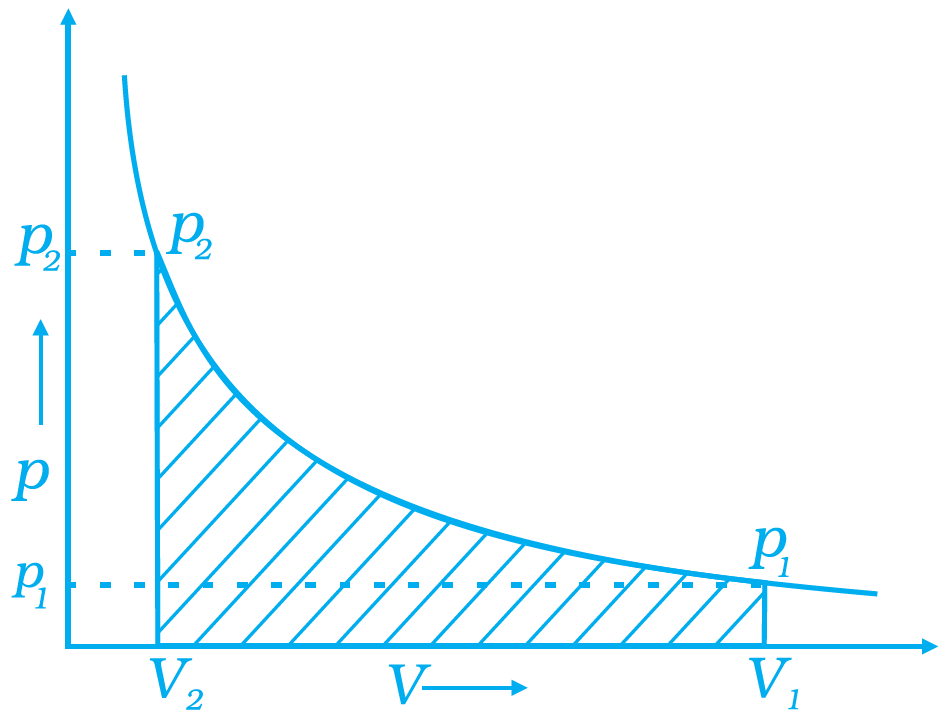
How will you calculate work done on an ideal gas in a compression, when change in pressure is carried out in infinite steps?

Answer


The work done can be calculated with the help of p–V plot. A p–V plot of the work of compression which is carried out by change in pressure in infinite steps, is given in Fig. Shaded area represents the work done on the gas.

Need a full question paper?

Generate a complete, print-ready paper with questions like this in minutes — across 16+ boards, with answer keys.
Start Generating Free

Similar questions

Account for the following.
  1. CO is used in the extraction of metals.
  2. CO is poisonous.
  3. $\mathrm{CO}_2$ is used in referigeration.
Standard molar enthalpy of formation, $\Delta_\text{f}\text{H}^\ominus$ is just a special case of enthalpy of reaction, $\Delta_\text{r}\text{H}^\ominus$. Is the $\Delta_\text{r}\text{H}^\ominus$ for the following reaction same as $\Delta_\text{f}\text{H}^\ominus$? Give reason for your answer.$\text{CaO}(\text{s})+\text{CO}_2(\text{g})\rightarrow\text{CaCO}_3(\text{s});$ $\Delta_\text{f}\text{H}^\ominus=-178.3\text{kJ}\ \text{mol}^{-1}$
The value of $\Delta_\text{f}\text{H}^\ominus$ for $NH_3$ is $-91.8kJ mol^{-1}$. Calculate enthalpy change for the following reaction:$2\text{NH}_3(\text{g})\rightarrow\text{N}_2(\text{g})+3\text{H}_2(\text{g})$
The diameter of zinc atom is 2.6 $\mathring{\text{A}}$.Calculate,
  1. Radius of zinc atom in pm
  2. Number of atoms present in a length of 1.6cm if the zinc atoms are arranged side by side lengthwise.
  1. Classify the following processes as reversible or irreversible:
  1. Dissolution of sodium chloride.
  2. Evaporation of water at 373K and 1atm pressure.
  3. Mixing of two gases by diffusion.
  4. Melting of ice without rise in temperature.
  1. When an ideal gas expands in vacuum, there is neither absorption nor evolution of heat. Why?
How will you convert benzene into:
m-nitrochlorobenzene.
QUESTION Calculate bond energy of C - H bond if $\Delta_{ c } H$ of $CH _4$, is $-891 kJ mol { }^{-1}, \Delta_c H$ of $C ( s )$ is $-394 kJ mol ^{-1}, \Delta_c H ^{-}$of $H _2(g)$ is $-286 kJ Jol ^{-1}$, heat of sublimation of $C ( s )$ is $717 kJ mol ^{-1}$, heat of dissociation of $H _2$ is $436 kJ mol ^{-1}$.
A mixture of oxalic acid and formic acid is heated with concentrated $H_2SO_4$ and the gas evolved is collected. On treating the solution with KOH, the volume of the solution decreases by $\frac{1}{6}^\text{th}$ Calculate the molar ratios of two acids in the original mixture.
  1. Why does water transported through lead pipes become poisonous?
  2. When formic acid reacts with conc $\text{H}_2\text{SO}_2$, what will happen? Write chemical equation?
  3. Name the allotrope of carbon which is isomorphous (same structure) with crystalline silicon.
  1. Using the data given below, calculate the value of equilibrium constant for the reaction at 298K.
$3\text{CH}\equiv\text{CH}(\text{g})\rightleftharpoons\text{C}_6\text{H}_6(\text{g})$ assuming ideal gas behaviour, $\Delta_\text{f}\text{G}^\circ[\text{HC}\equiv\text{CH(g)}]=2.09\times10^5\text{J mol}^{-1},$ $\Delta_\text{f}\text{G}^\circ[\text{C}_6\text{H}_6(\text{g})]=1.24\times10^5\text{J mol}^{-1}, \mathrm{R}=8.314 \mathrm{JK}^{-1} \mathrm{~mol}^{-1}$.
  1. Based on your calculated value, comment whether this process can be recommended as a practical method for making benzene.
A transluscent white waxy solid (A) on heating in inert atmosphere is converted into its allotropic form ' B '. Allotrope ' A ', on reaction with very dilute aqueous solution of KOH liberates highly poisonous gas (C) having rotten fish smell. With excess of chlorine (C) forms (D) which hydrolyse to a compound 'E'. Identify A to E giving chemical equations.