Question
How will you concentrate $H _2 O _2$ ? Show differences between structures of $H _2 O _2$ and $H _2 O$ by drawing their spatial structures. Also mention three important uses of $H _2 O _2$.
Answer

Methods for concentrating hydrogen peroxide and obtaining this compound in anhydrous form, based on removal or binding of water from the surface of solution in an open vessel or in a closed volume and also on binding of water directly in a $H _2 O _2$ solution, are described.
Differences between structures of $H _2 O _2$ and $H _2 O ^{-}$
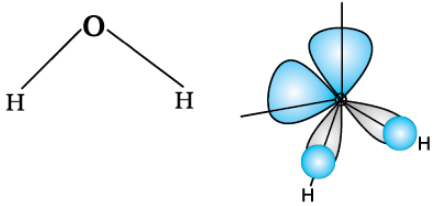
In gaseous phase, water molecule $\left( H _2 O \right)$ has a bent form with a bond angle of $104.5^{\circ}$. The $O - H$ bond length is 95.7 pm . The structure of $H _2 O$ can be shown as:

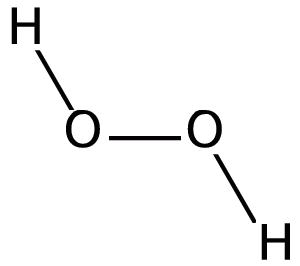
Hydrogen peroxide has a non-planar structure both in gas and solid phase. The dihedral angle in gas and solid phase is $111.5^\circ$ and $90.2^\circ$ respectively. The structure of $H_2O_2$ can be shown as:

Uses- Hydrogen peroxide is a mild antiseptic used on the skin to prevent infection of minor cuts, scrapes, and burns. It may also be used as a mouth rinse to help remove mucus or to relieve minor mouth irritation (e.g., due to canker/ cold sores, gingivitis). This product works by releasing oxygen when it is applied to the affected area. The release of oxygen causes foaming, which helps to remove dead skin and clean the area.

Need a full question paper?

Generate a complete, print-ready paper with questions like this in minutes — across 16+ boards, with answer keys.

Start Generating Free

Similar questions

Give the shapes of following covalent molecules using VSEPR theory:
i. $\mathrm{ClF}_3$
ii. $\mathrm{XeF}_4$
iii. $\mathrm{AsF}_5$
Similar to electron diffraction, neutron diffraction microscope is also used for the determination of the structure of molecules. If the wavelength used here is 800 pm . Calculate the characteristic velocity associated with the neutron.
A mixture of CO and $CO_2$ is found to have a density of $1.50gL^{-1}$ at 20°C and 740mm pressure. Calculate the composition of the mixture.
Why does water covered with excessive algal growth become polluted?
With help of following values calculate energy of $> C = C <$ bond :
$
\begin{array}{l}
2 C(s)+2 H_2(g)=C_2 H_4(g) ; \Delta H=52.6 kJ \\
C(s) \rightarrow C(g) ; \Delta H=716.68 kJ \\
H_2(g)=2 H(g) ; \Delta H=435.84 kJ \\
\text { and } C-H \text { bond energy }=+413 kJ
\end{array}
$
An element with mass number 81 contains 31.7% more neutrons as compared to protons. Assign the atomic symbol.
Given$\text{N}_2(\text{g}) + 3\text{H}_2(\text{g}) \xrightarrow{ \ \ \ \ \ \ }2\text{NH}_3(\text{g}) ; \Delta_{\text{r}}\text{H}^\ominus= –92.4\text{kJ} \ \text{mol}^{–1}$
What is the standard enthalpy of formation of $\text{NH}_{3}$ gas?
  1. Calculate the mole fraction of water in a mixture of $15g$ water, $18g$ acetic acid and $84g$ ethyl alcohol.
  2. Excess the following numbers to four significant figures.
  • $3.607892$
  • $6.5869 \times 10^3$
  1. Write balanced chemical equation for the following:
$KMnO_4 + C_2H_4 + H_2O → MnO_2 +KOH+ (CH_2OH)_2$
Use the following data to calculate the $\Delta \mathrm{G}^{\circ}$ for the reaction in which $\mathrm{PF}_5(\mathrm{~g})$ forms from $\mathrm{PF}_3(\mathrm{~g})$ and $\mathrm{F}_2(\mathrm{~g})$ at 298 K .
$\mathrm{PF}_3(\mathrm{~g})+\mathrm{F}_2(\mathrm{~g}) \rightarrow \mathrm{PF}_5(\mathrm{~g})$
​​​​​​​$\begin{matrix}\Delta \text{H}^{\circ}_{f} & -919 \text{kJ mol}^{-1} & 0 & -1577 \text{kJ} \text{ K}^{-1} \text{mol}^{-1} \ \\\text{S}^{\circ}& 273 & 203 & 301 \end{matrix}$
 
One mole of any substance contains $6.022 \times 10^{22}$ atoms/ molecules. Calculate the number of molecules of $\mathrm{H}_2 \mathrm{SO}_4$ present in 100 mL of $0.02 \mathrm{M} \mathrm{~H}_2 \mathrm{SO}_4$ Solution.