Question
How will you find out whether an object is charged or not?

Answer

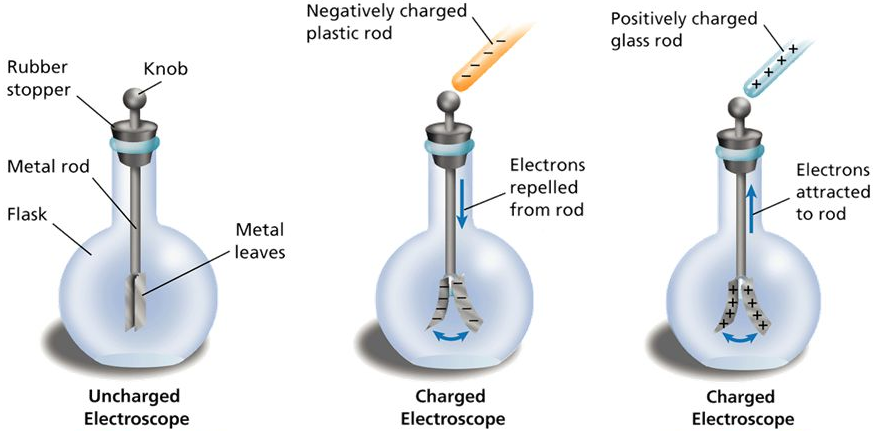
In order to find out if an object is charged or not, we can test it by using an electroscope.
$i.$ When the object is touched with the metal cap of an electroscope, both the metal cap and the leaves acquire the charge due to conduction. As a result of.
$ii.$  As a result of both, the leaves of the electroscope will have the same charge. It will cause the leaves to diverge showing that the object was charged,
as shown in the pic:

Need a full question paper?

Generate a complete, print-ready paper with questions like this in minutes — across 16+ boards, with answer keys.

Start Generating Free

Similar questions

What is the process of ‘transplantation’ in agriculture? Give examples of two crops which are usually grown by this process.
What are synthetic fibres? Name any two synthetic fibres.
Sakshi and her mother reached a jewellery shop to purchase some ornaments. She liked a bangle set very much but her mother asked not to purchase that because that was not a real gold. She asked the shopkeeper about it. The shopkeeper explained the process of gold plating, this process is also known as electroplating.
(i) Name some other materials which are used for electroplating.
(ii) What is the need of electroplating in the above case? Give one more use of electroplating.
When a copper object is exposed to moist air for a long time, then a green coating is formed on its surface.
$a.$ What is the material of the green coating?
$b.$ State whether the green coating is acidic or basic.
Why should we keep doors and windows open when high-speed winds blow over our houses?
In the process of purification of copper metal, a thin plate of pure copper and a thick rod of impure copper are used as electrodes, and a metal salt solution is used as an electrolyte:
$a.$ Which electrode is connected to the positive terminal of the battery?
$b.$ Which electrode is connected to the negative terminal of the battery?
$c.$ Which metal salt solution is taken as electrolyte?
Consider the following reaction where two substances, A and B, combine to form a product C:
A + B → C
Assume that A and B cannot be broken down into simpler substances by chemical reactions. Based on this information, which of the following statements is correct?
(i) A, B, and C are all compounds, and only C has a fixed composition.
(ii) C is a compound, and A and B have a fixed composition.
(iii) A and B are compounds, and C has a fixed composition.
(iv) A and B are elements, C is a compound, and has a fixed composition.
Draw a diagram of Ursa Major constellation to show the position of main stars in it.
Why should we avoid standing close to a tuberculosis patient while he/ she is coughing?
Explain lateral inversion with an example.