Question
How will you infer with the help of an experiment that the same current flows through every part of the circuit containing three resistances in series connected to a battery?
Answer

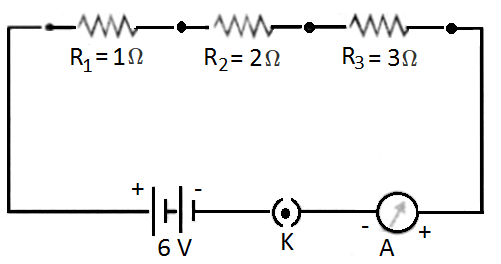
Perform an activity to show that in series combination of resistors, same current flows through each resistor.
  1. Connect three resistors of resistances R1 = 1Ω, R2 = 2Ω and R3 = 3Ω in series.
  2. Connect the series combination of resistors with a battery of 6V, a plug key K and an ammeter A as shown in figure.


  1. Note the reading of ammeter after plugging the key. Let it be I.
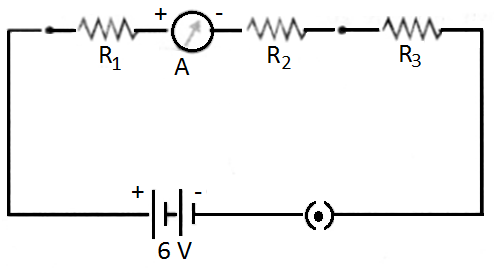
  2. Now disconnect ammeter and connect it in between the resistors R1 and R2 as shown in figure.

​​​​​​​
  1. Again plug the key and note the reading of ammeter. It is found that again it is I.
  2. Now disconnect the ammeter and connect it in between the resistors R2 and R3.
  3. Plug the key and note the reading of ammeter. Again it is found to be I.

Need a full question paper?

Generate a complete, print-ready paper with questions like this in minutes — across 16+ boards, with answer keys.
Start Generating Free

Similar questions

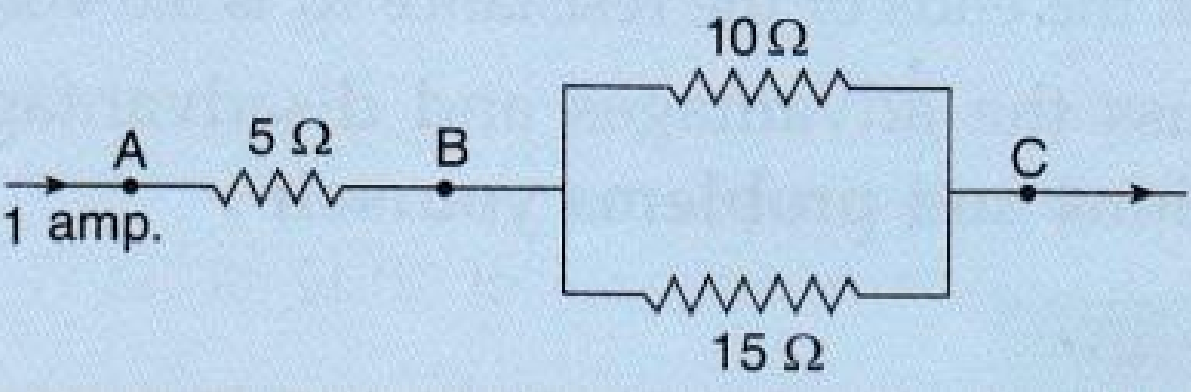
Three resistors are connected as shown in the diagram.

Through the resistor 5 ohm, a current of 1 ampere is flowing,
  1. What is the current through the other two resistors?
  2. What is the p.d. across AB and across AC?
  3. What is the total resistance?
  1. A person cannot read newspaper placed nearer than 50 cm from his eyes. Name the defect of vision he is suffering from. Draw a ray diagram to illustrate this defect. List its two possible causes. Draw a ray diagram to show how this defect may be corrected using a lens of appropriate focal length.
  2. We see advertisements for eye donation on television or in newspapers. Write the importance of such advertisements.
A concave lens of focal length 60 cm is used to form an image of an object of length 9 cm kept at a distance of 30 cm from it. Use lens formula to determine the nature, position and length of the image formed. Also draw labelled ray diagram to show the image formation in the above case.
What is meant by power of a lens? Define its S.I. unit.

You have two lenses A and B of focal lengths +10cm and -10cm respectively. State the nature and power of each lens. Which of the two lenses will form a virtual and magnified image of an object placed 8cm from the lens? Draw a ray diagram to justify your answer.

It is desired to obtain an erect image of an object, using concave mirror of focal length of 12 cm.
  1. What should be the range of distance of an object placed in front of the mirror?
  2. Will the image be smaller or larger than the object. Draw ray diagram to show the formation of image in this case.
  3. Where will the image of this object be, if it is placed 24 cm in front of the mirror? Draw ray diagram for this situation also to justify your answer.
Show the positions of pole, principal focus and the centre of curvature in the above ray diagrams.
  1. Draw a ray diagram to explain the term angle of deviation.
  2. Why do the component colours of incident white light split into a spectrum while passing through a glass prism, explain.
  3. Draw a labelled ray diagram to show the formation of a rainbow.
Draw the labelled diagram of an A.C. generator. With the help of this diagram, explain the construction and working of an A.C. generator.
  1. If the image formed by a lens is diminished in size and erect, for all positions of the object, what type of lens is it?
  2. Name the point on the lens through which a ray of light passes undeviated.
  3. An object is placed perpendicular to the principal axis of a convex lens of focal length 20cm. The distance of the object from the lens is 30cm. Find,
  1. The position.
  2. The magnification.
  3. The nature of the image formed.
i. A person suffering from myopia (near-sightedness) was advised to wear the corrective lens of power -2.5 D . A spherical lens of the same focal length was taken in the laboratory. At what distance should a student place an object from this lens so that it forms an image at a distance of 10 cm from the lens?
ii. Draw a ray diagram to show the position and nature of the image formed in the above case.
  1. Explain the following terms related to spherical lenses:
  1. Optical centre.
  2. Centres of curvature.
  3. Principal axis.
  4. Aperture.
  5. Principal focus.
  6. Focal length.
  1. A converging lens has focal length of 12 cm. Calculate at what distance should the object be placed from the lens so that it forms an image at 48 cm on the other side of the lens.