Question
How will you measure the diameter of a wire using a screw gauge?

Answer

The following procedure is used to measure the diameter of a wire
(a). Calculate the least count and zero error of the screw gauge.
(b). Place the wire in between the studs. Turn the ratchet clockwise so as to hold the wire gently in between the studs. Record the main scale reading.
(c). Now record the division of circular scale that coincides with the base line of the main scale. This circular scale division multiplied by the least count will give circular scale reading.
(d). The observed diameter is obtained by adding the circular scale reading to the main scale reading. Subtract the zero error if any, with its proper sign, from the observed diameter to get the true diameter.

Need a full question paper?

Generate a complete, print-ready paper with questions like this in minutes — across 16+ boards, with answer keys.
Start Generating Free

Similar questions

A wooden cube of side $10$ cm has a mass of $700 $g. It will float in the water with:
(a) Half of its volume inside the water
(b) $3$ cm height above the water surface
(c) $7$ cm height above the water surface
(d) Just inside the water surface.
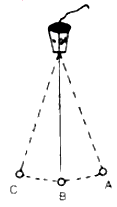
If a pendulum takes 0.5 s to travel from A to B as shown in the following figure, find its time period and frequency.
The pitch of a screw gauge is 1 mm and the circular scale has 100 divisions. In measurement of the diameter of a wire, the main scale reads 2 mm and 45th mark on the circular scale coincides with the base line. Find
(i) The least count and
(ii) The diameter of the wire.
A weather forecasting plastic balloon of volume $15 m^3$ contains hydrogen of density $0.09 kg m ^{-3}$. The volume of equipment carried by the balloon is negligible compared to its own volume. The mass of an empty balloon alone is 7.15 kg . The balloon is floating in air of density of $1.3 kg m ^{-3}$. Calculate:
(i) The mass of hydrogen in the balloon,
(ii) The mass of hydrogen and balloon,
(iii) The total mass of hydrogen, balloon and equipment if the mass of equipment is $x kg$,
(iv) The mass of air displaced by balloon and
(v) The mass of equipment using the law of floatation.
A simple $U$ tube contains mercury to the same level in both of its arms. If water is poured to a height of 13.6 cm in one arm, how much will be the rise in mercury level in the other arm? Given : density of mercury $=13.6 \times 10^3 kg m ^{-3}$ and density of water $=$ $10^3 kg m ^{-3}$.
How does the presentation of data in a tabular form help us in analyzing them? Explain with one example.
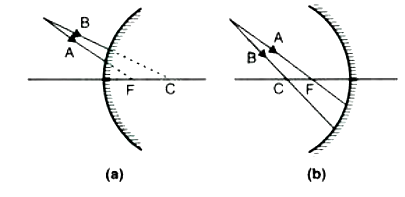
Complete the following diagrams shown in Fig. by drawing the reflected ray for each of the incident ray A and B.