Question
How will you separate a mixture containing kerosene and petrol (difference in their boiling points is more than 25ºC), which are miscible with each other?
Answer

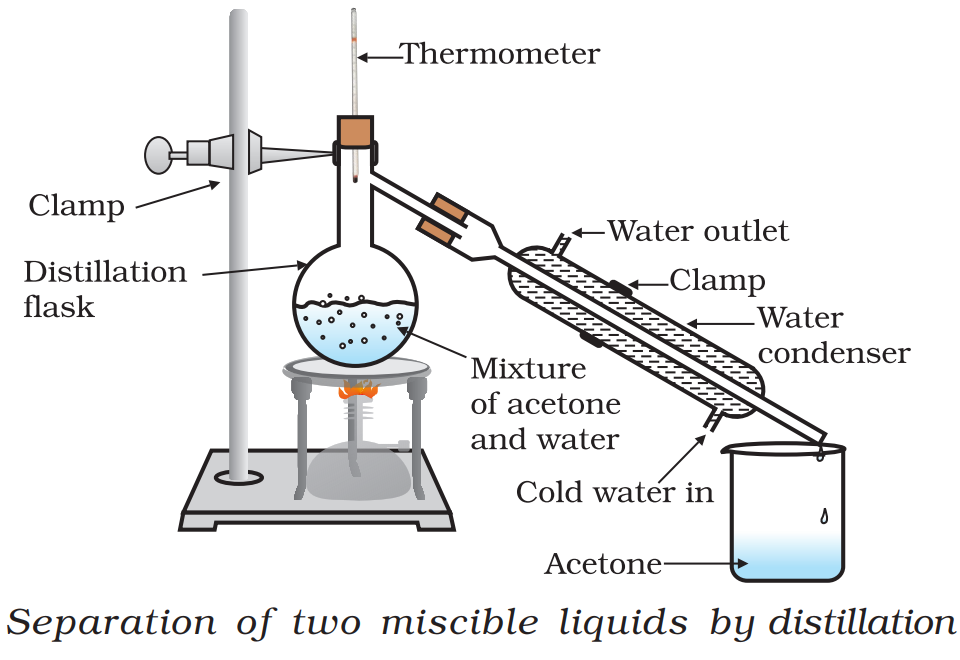
A mixture of two miscible liquids having a difference in their boiling points more than 25°C can be separated by the method of distillation. Thus, kerosene and petrol can be separated by distillation.

In this method, the mixture of kerosene and petrol is taken in a distillation flask with a thermometer fitted in it. We also need a beaker, a water condenser, and a Bunsen burner. The apparatus is arranged as shown in the above figure. Then, the mixture is heated slowly. The thermometer should be watched simultaneously. Kerosene will vaporize and condense in the water condenser. The condensed kerosene is collected from the condenser outlet, whereas petrol is left behind in the distillation flask.

Need a full question paper?

Generate a complete, print-ready paper with questions like this in minutes — across 16+ boards, with answer keys.

Start Generating Free

Similar questions

Define relative density of a solid. State its unit. How is it related to its density? Write mathematical expression for relative density. What conclusion do you draw if relative density of a substance is (a) greater than 1, (b) less than 1 and (c) equal to 1?
On the basis of shape and functions of cells how epithelial tissues are classified? Explain with diagram the various types of epithelial tissues.
Two objects having equal masses are moving with uniform velocities of 2m/s and 6m/s respectively. Calculate the ratio of their kinetic energies.
A stone falls from a building and reaches the ground $2.5$ seconds later. How high is the building? $(g = 8\ m/s^2)$
What is a soundboard? Explain the working of a soundboard with the help of a labelled diagram.
Define muscular tissue, Classify and explain different types of muscles with the help of suitable diagrams.

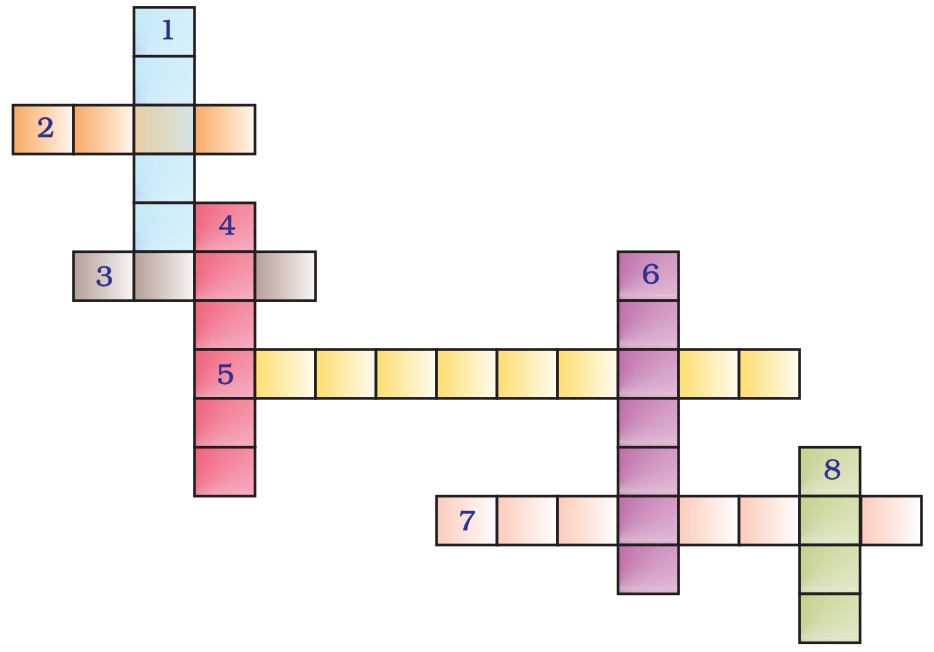
Complete the following crossword puzzle (Figure) by using the name of the chemical elements. Use the data given in the table following.
Across
Down
2.
The element used by Rutherford during his $\alpha$–scattering experiment.
1.
A white lustrous metal used for making ornaments and which tends to get tarnished black in the presence of moist air.
3.
An element which forms rust on exposure to moist air.
4.
Both brass and bronze are alloys of the element.
5.
A very reactive non–metal stored under water.
6.
The metal which exists in the liquid state at room temperature.
7.
Zinc metal when treated with dilute hydrochloric acid produces a gas of this element which when tested with burning splinter produces a pop sound.
8.
An element with symbol Pb.
How is green revolution different from white revolution?
How does sound from a sound producing body travel through air to reach our ears? Illustrate your answer with the help of a labelled diagram.
When a beam of sunlight enters a room through a window, we can see tiny particles X suspended in a gas (or rather a mixture of gases) Y which are moving rapidly in a very haphazard manner.
  1. What could particles X be?
  2. Name the gas (or mixture of gases) Y.
  3. What is the phenomenon exhibited by particles X known as?
  4. What is causing the movement of particles X?
  5. What conclusion does the existence of this phenomenon give us about the nature of matter?