Question
How will you separate a mixture containing kerosene and petrol (difference in their boiling points is more than $25^\circ\ C$), which are miscible with each other?
Answer

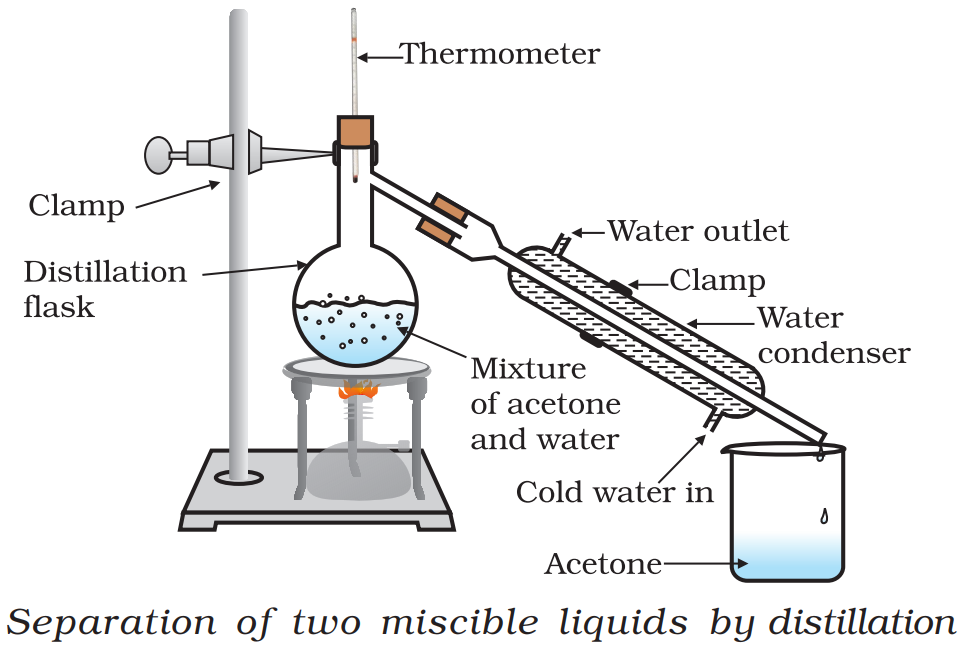
A mixture of two miscible liquids having a difference in their boiling points more than $25^\circ\ C$ can be separated by the method of distillation. Thus, kerosene and petrol can be separated by distillation.

In this method, the mixture of kerosene and petrol is taken in a distillation flask with a thermometer fitted in it. We also need a beaker, a water condenser, and a Bunsen burner. The apparatus is arranged as shown in the above figure. Then, the mixture is heated slowly. The thermometer should be watched simultaneously. Kerosene will vaporize and condense in the water condenser. The condensed kerosene is collected from the condenser outlet, whereas petrol is left behind in the distillation flask.

Need a full question paper?

Generate a complete, print-ready paper with questions like this in minutes — across 16+ boards, with answer keys.

Start Generating Free

Similar questions

How bee colony works? What values can be seen in the organization of bee colony?
Define diarrhoea. Give an account of occurrence, symptoms, prevention and control of this ailment.
Draw well labelled diagrams of various type of muscles found in human body.
Two objects having equal masses are moving with uniform velocities of $2m/s$ and $6m/s$ respectively. Calculate the ratio of their kinetic energies.
What is hierarchy of categories? Describe the same.
Derive the unit of force using the second law of motion. A force of $5\ N$ produces an acceleration of $8 m\mathrm{s}^{-2}$ on a mass $\mathrm{m}_1$ and an acceleration of $24 \mathrm{~m} \mathrm{~s}^{-2}$ on a mass $\mathrm{m}_2$. What acceleration would the same force provide if both the masses are tied together$?$
From a cliff of $49 m$ high, a man drops a stone. One second later, he throws another stone. They both hit the ground at the same time. Find out the speed with which he threw the second stone.
Carry out the following osmosis experiment: Take four peeled potato halves and scoop each one out to make potato cups, one of these potato cups should be made from a boiled potato. Put each potato cup in a trough containing water. Now,
  1. Keep cup $A$ empty.
  2. Put one teaspoon sugar in cup $B$.
  3. Put one teaspoon salt in cup $C$.
  4. Put one teaspoon sugar in the boiled potato cup $D$.
Keep these for two hours. Then observe the four potato cups and answer the following:
  1. Explain why water gathers in the hollowed portion of $B$ and $C$.
  2. Why is potato $A$ necessary for this experiment?
  3. Explain why water does not gather in the hollowed out portions of $A$ and $D$.
Define soil erosion. Give its causes, effects and preventive measures.
Write short note on protochordates.