Question
How will you separate camphor, common salt and iron nails from their mixture?

Answer

A horse-shoe magnet is moved on the surface of the mixture of camphor, common salt and iron nails. The iron nails are attracted by the magnet, they cling to the poles of the magnet and get separated. This process is repeated a number of times till complete separation of iron nails occur leaving behind mixture of camphor and common salt. Mixture of camphor and common salt is heated. Camphor sublimes on heating leaving behind common salt and can be recovered in the form of sublimate by cooling its vapours.

Need a full question paper?

Generate a complete, print-ready paper with questions like this in minutes — across 16+ boards, with answer keys.
Start Generating Free

Similar questions

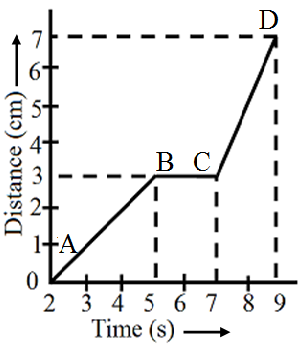
The graph given alogside shows the positions of a body at different times. Calculate the speed of the body as it moves from:
  1. A to B.
  2. B to C.
  3. C to D.
Why bee keeping should be done in good pasturage?
Show by using the graphical method that:
$\text{s}=\text{ut}+\frac{1}{2}\text{at}^2$
where the symbols have their usual meanings.
How are simple tissues different from complex tissues in plants?
What is osmosis?
In an experiment, $4.90g$ of copper oxide was obtained form $3.92g$ of copper. In another experiment, $4.55g$ of copper oxide gave, on reduction, $3.64g$ of copper. Show with the help of calculations that these figures verify the law of constant proportions.
The mass of one molecule of a substance is $4.65 \times 10^{-23}g.$ What is its molecular mass? What could this substance be?
A boy of mass $50\ kg$ running at $5m/s$ jumps on to a $20\ kg$ trolley travelling in the same direction at $1.5m/s$. What is their common velocity?
There are three substances X, Y and Z. The substance X does not have a fixed melting point or boiling point and it still shows the individual properties of its constituents. The substance Y is a pure substance which occurs in nature as such. The substance Y has a fixed melting point and boiling point but it cannot be broken down into simpler substances by any chemical means. The substance Z is also a pure substance whose properties are entirely different from those of its constituents. The substance Z can, however, be divided by electrolysis into two substances which belong to the same class of substances as Y.
  1. What type of substance could X be? Name one substance like X.
  2. What type of substance could Y be? Name one substance like Y.
  3. What type of substance could Z be? Name one substance like Z.
  4. Whish process involves absorption or release of an appreciable amount of energy: formation of substance X or formation of substance Z?
  5. Name the three groups into which all the substances like Y are divided on the basis of their properties.
Draw a labelled diagram of a neuron.