MCQ
Human eye:
- ACan detect polarized light
- BCannot detect polarization of light
- CCan detect only circularly polarized light
- DCan detect only linearly polarized light
Explanation:
Polarization changes when plane of vibration of polarized light changes.
Human eye is insensitive to change in polarization and hence, cannot detect polarization of light.
Generate a complete, print-ready paper with questions like this in minutes — across 16+ boards, with answer keys.
The thermo e.m.f. of a thermo-couple is 25μV/℃ at room temperature. A galvanometer of 40 ohm resistance, capable of detecting current as low as  , is connected with the thermocouple. The smallest temperature difference that can be detected by this system is
|
(a) 20 ℃ |
(b) 16 ℃ |
(c) 12 ℃ |
(d) 8℃ |
The diagram of a logic circuit is given below. The output F of the circuit is represented by
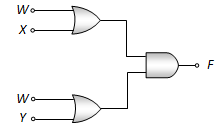
|
(a) W.(X + Y) |
(b) W.(X.Y) |
(c) W + (X.Y) |
(d) W + (X + Y) |
Wires P and Q have the same resistance at ordinary (room) temperature. When heated, resistance of P increases and that of Q decreases. We conclude that
|
(a) P and Q are conductors of different materials |
|
(b) P is N-type semiconductor and Q is P-type semiconductor |
|
(c) P is semiconductor and Q is conductor |
|
(d) P is conductor and Q is semiconductor |
Long distance short-wave radio broadcasting uses
|
(a) Ground wave |
(b) Ionospheric wave |
(c) Direct wave |
(d) Sky wave |
Two conductors made of the same material are connected across a common potential difference. Conductor A has twice the diameter and twice the length of conductor B. The power delivered to the two conductors  and
and  respectively is such that
  equals to
|
(a) 0.5 |
(b) 1.0 |
(c) 1.5 |
(d) 2.0 |