MCQ
Huygen's concept of wavelets is useful in:
  • A
    Explaining polarisation
  • B
    Determining focal length of lenses
  • C
    Determining chromatic aberration
  • Geometrical reconstruction of a wavefront

Answer

Correct option: D.
Geometrical reconstruction of a wavefront

Huygens considered that light was propagated in longitudinal waves.
Huygen's concept explained the direction of propagation of light waves by geometrical reconstruction of wavefront.

Need a full question paper?

Generate a complete, print-ready paper with questions like this in minutes — across 16+ boards, with answer keys.
Start Generating Free

Similar questions

Susceptibility is positive and large for a:
Light of wavelength $5000\,\mathop A\limits^o$ is incident on a single slit such that first minima is formed at a distance $5\, mm$ from the centre. If the screen is placed $2\, m$ away then find the width of slit.....$ mm$
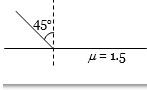
One side of a glass slab is silvered as shown. A ray of light is incident on the other side at angle of incidence $i = {45^o}$. Refractive index of glass is given as $1.5$. The deviation of the ray of light from its initial path when it comes out of the slab is......$^o$
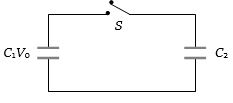
A capacitor of capacity ${C_1}$ is charged to the potential of ${V_o}$. On disconnecting with the battery, it is connected with a capacitor of capacity ${C_2}$ as shown in the adjoining figure. The ratio of energies before and after the connection of switch $S$ will be
Hydrogen atom emits blue light when it changes from $n = 4$ energy level to the $n = 2$ level. Which colour of light would the atom emit when it changes from the $n = 5$ level to the $n = 2$ level
A $1\,m$ long copper wire carries a current of $1\,A$. If the cross section of the wire is $2.0\,mm ^{2}$ and the resistivity of copper is $1.7 \times 10^{-8}\,\Omega\,m$. the force experienced by moving electron in the wire is $\times 10^{-23}\,N$. (charge on electron $=1.6 \times 10^{-19}\,C$ )
The minimum energy required to remove an electron is called:
A proton and an electron are placed in a uniform electric field.
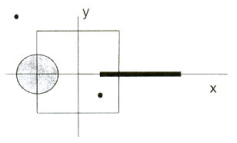
A disk of radius $a / 4$ having a uniformly distributed charge $6 \mathrm{C}$ is placed in the $x-y$ plane with its centre at $(-a / 2,0,0)$. A rod of length $a$ carrying a uniformly distributed charge $8 \mathrm{C}$ is placed on the $x$-axis from $x=a / 4$ to $x=5 a / 4$. Two point charges $-7 \mathrm{C}$ and $3 \mathrm{C}$ are placed at $(a / 4,-a / 4,0)$ and $(-3 a / 4,3 a / 4,0)$, respectively. Consider a cubical surface formed by six surfaces $x= \pm a / 2, y= \pm a / 2$, $z= \pm a / 2$. The electric flux through this cubical surface is
Assertion : X-rays can penetrate through the flesh but not through the bones.
Reason : The penetrating power of X-rays depends on voltage.