MCQ
Huygens' wave theory is used:
- ATo determine the velocity of light.
- BTo find the position of the wave front.
- CTo determine the wavelength of light.
- DTo find the focal length of a lens.
Explanation:
Huygen proposed a hypothesis for the geometrical construction of the position of a common wavefront at any instant during the propogation of waves in a medium.
Generate a complete, print-ready paper with questions like this in minutes — across 16+ boards, with answer keys.
In the circuit shown in figure, each capacitor has a capacity of 3μF. The equivalent capacity between A and B is
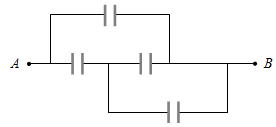
|
(a) |
(b) 3 |
(c) 6 |
(d) 5 |
A convex lens of ______ focal length gives a greater magnification than lenses of _______ focal length.
Assertion : The electrical conductivity of earth's atmosphere decreases with altitude.
Reason : The high energy particles (i.e. 𝛾-rays and cosmic rays) coming from outer space and entering our earth's atmosphere cause ionisation of the atoms of the gases present there and the pressure of gases decreases with increase in altitude.
|
(a) If both assertion and reason are true and the reason is the correct explanation of the assertion. |
|
(b) If both assertion and reason are true but reason is not the correct explanation of the assertion. |
|
(c) If assertion is true but reason is false. |
|
(d) If assertion is false but reason is true. |
The mechanism of the heat produced in a conductor when an electric current flows through it, can be explained on the basis of
|
(a) Viscosity |
(b) Friction |
(c) Free electron theory |
(d) Gauss's theorem |

